The Scratch Interview #8: Deesha Philyaw on Literary Community, Part II
“The last thing we need when we're trying to make art is to feel ashamed by what we don't have, and yet here we are.”
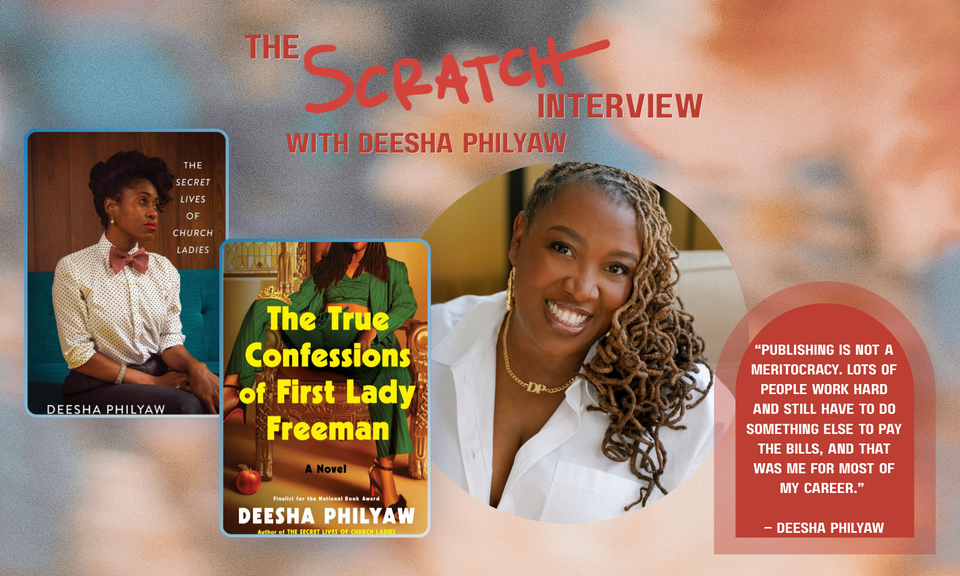
Hello Scratch readers! First of all, if you’re reading this, and you haven’t yet read Deesha Philyaw Part I, go here to give that a read.
Latria’s interview with Deesha Philyaw was so generous and full that we decided you all deserved two installments. This part of the interview centers on literary community and citizenship and how Deesha makes that a very intentional part of her practice — and how she decides on boundaries around her own time and energy within all of that.
ICYMI, we’re rolling out The Scratch Mailbag! Click here for instructions on how to send us all of your burning questions about writing, publishing, and survival.
OK, here’s Part 2, with Latria and Deesha.
— Team Scratch
*Note: This post contains Bookshop.org affiliate links. Purchases made through them directly support independent bookshops and help keep Scratch running.
The following interview has been lightly edited for length and clarity.
Latria Graham: I want to spend a little time talking about the community and writing aspect of this because over the years I’ve seen you advocate for folks who might be overlooked. But you’ve also talked about friends supporting you, like paying your rent for a year, or doing their best to make sure that if they got a contract they can get you work, too. How does that happen? And why is that important?
Deesha Philyaw: I've had moments with writer friends where we pass the same $200 back and forth. It has been a journey to get to a place of being willing to ask for help because, as with everything with shame, it's like the wrong people have it. The people who should be ashamed around money are billionaires, because as long as they're billionaires, there should not be people who don't have the basic necessities of life. And yet it's poor people who are ashamed.
Growing up working class — I mean we would call it poor now, but I didn't think of myself as poor, but my mom and my grandmother struggled — I felt very ashamed compared to my peers who were all solidly middle-class when I was not. And then I went to Yale, and you can imagine how that went.
Yeah… Dartmouth is not Yale, but it's still…
Yes, it's the same vibe. There was nothing for me to be ashamed of, for any of us to be ashamed of if we have needs, if we're not able to make ends meet with the money that we make as we're trying to make art. This country's not set up for that in general, and then under the current administration we’re losing things like the NEA and these other opportunities, so there are even fewer resources. And so the last thing we need when we're trying to make art is to feel ashamed by what we don't have, and yet here we are. What I have tried to do when I've had money, when I have had a cushion, is tried to offer my friends money so they don't have to ask, because I know how hard it is to ask. I know I hate asking. I've gotten better about it and less ashamed, but still it's hard to do.
Here at my desk I’ve got a copy of An Anthology of Rural Stories by Writers of Color, 2025 an anthology that you put out with EastOver Press. What does it mean to be able to put together something like this, a collection highlighting an overlooked form and an overlooked locale for artists? And to be able to say, "Hey people, look at these writers"?
When we were talking about the rates that we get paid and how there's very little we can do about that in terms of affecting change in this industry, being in the rooms when collections are being put together or contests are being judged and things like that, that is another way we can affect change.
We can open doors and hold them open for other people and expand the notions and the assumptions about who falls under these categories, who gets published in these things, who wins these prizes? What does it mean to be a rural writer? What is a rural story? And so when I am invited to do things like that, I'm trying to think of it as expansively as possible and also as subversively as possible. Who would somebody think shouldn't be in this space? Or who will people be surprised to see in this space? And that's usually what I'm looking for.
I think there's too often this push for conformity, in that if this very narrow band of people and experiences get published, some people contort themselves and think, Oh, well, I have to emulate that or I have to limit my imagination to fit this style in order to get published. And I want to make sure to the extent that I can, when it's in my power, to publish people who are willing to say, I'm just going to be weird on the page. And when I say weird, it doesn't necessarily have to be quirky, but just that it goes against the grain of what we're told is good art or good literature. When I assemble work, I’m expanding that to include people that publications historically have not been open to. And I assume that when a publication invites me to edit an anthology or judge a contest, that's why they're choosing me. And so I am not going to disappoint.
Enjoying Scratch? The best way to support our work is with a paid subscription!
Right—this is one of the things you taught me a couple of years ago, and it’s one of the reasons I read for so many residencies, fellowships, and prizes. A couple of years ago you volunteered to read first-round applications for the Cato Fellowship. You explained to me that people like us being in the room meant that certain writers might get understood in a way that they may not have encountered before. I’ve seen it with my own work. I often utilize a kind of circular storytelling often found in the South, and sometimes I get feedback that makes me go "Oh, they don't understand what I've written, so they don't know how to judge it, or they don't know what to do with it." They're seeing it as extraneous repetition, whereas we're seeing it as this idea of cultural repetition and this idea perhaps in Black spaces that repetition is holy, which is a whole different thing.
Whole different. And so that's the thing, instead of saying that we are lacking something from a craft standpoint, they are lacking cultural competency. And that is an important distinction. And I think it's important for people to say, "I don't have the cultural competency to weigh in on this. Or I worry that I might give it short shrift because of my cultural limitations." But first you got to see yourself as having a culture. Understanding that whether it's white privilege or other privileges, that there's something there that might get between the critic/judge and fully being able to grasp what this writer is doing. I think that's so important to step aside in those cases. There have been times when I'm looking at something, and I lack the cultural competence for whatever is on the page, and I'll reach out to someone else who I know has more cultural competence than me. But I think people who are more interested in gatekeeping, they won't allow themselves to do that. They believe that they are the arbiters of excellence, not understanding their own limitations.
You’re so candid in the ways that you engage with emerging writers, and you’re really good at sharing what you’ve learned on social media. I'm hearing all the ways that you were held by others, and now I see some of the ways that you are also showing up for other people. One of those is a resource that creatives can pass around, called “Writer Beware,” which you created with Diamond A. Williamson. Can you talk a little bit about the why behind that project and what were you seeing happen in the community?
So Diamond and I came up with that Writer Beware resource during a very naive time. I'll speak for myself, I won't speak for Diamond, but I was naive in that I just thought, well, if people just knew. I had no idea at that time just how much misinformation proliferates on Threads. I believe it's worse than Twitter ever was.
Really?
It is so disturbing. And so it was like I saw people saying things like, "This is why I hate traditional publishing. Because I got scammed. I paid for this." And it's like, "Let me stop you right there. If you pay for something, that was not traditional publishing." But people don't know what they don't know. And at least that's how I was taking it and saying, "Well, if people understood, then they'd understand that this is something else." And far be it from me to defend traditional publishing, because it does have its failings, but there's enough real failings, we don't have to make stuff up. And if we are not clear on what is and isn't traditional publishing and what is scamming, people are going to get got.
I'm proud of what we put out there and I've heard from people that it’s helpful and they've passed it on to their students off of Threads. But it feels like swimming up tide with all of the misinformation. People's intentions… sometimes they’re looking for reasons to justify why things haven't worked out for them. Because there's just something on Threads about people's obsession with getting published. And I just wish they were more obsessed with writing well. And that's not to say that everybody who's not published is because their work isn't great, because we know lots of great books get overlooked. But I don't see the same fervor or passion for, "I'm really trying to get better at this thing with my writing." Or just talking about writing and loving it or having an attitude about writing like when Toni Morrison said, "If all the publishers had disappeared in one night, I would have written anyway." But we're inundated with people who are obsessed with how to get an agent, how to get published, and all the ways that traditional publishing has disappointed them.
So we created that when I was naive enough to think that people just needed to have this information. But what I found is people don't want that information. They're dealing in an unhealthy way with their disappointment about how this has all worked out. And so in fact, there's a hostility to when you correct the misinformation sometimes, because again, this is what the narrative that people need to tell themselves to be able to sleep at night. And they have decided that this is how it is. And when you come with facts and say, "Actually, no, that's not how it is," from somebody who's actually had the experience, as opposed to people who have all of these grand ideas and assumptions… and they don't understand that traditional publishing is broad, and so one person's experience or even ten people’s experiences are not necessarily reflective of the entire industry, that perspective is not welcome. It's like, "Oh, you're just gatekeeping."
Eventually you just get exhausted, and you just take it to the group chat. And so there are several writers that are in DMs on Threads or in group chats, and we'll look at the nonsense du jour and just do our primal scream in the group chat because we know it's a fool's errand to try and correct some of this stuff.
Maybe some of this foundational wisdom finds the right people later.
Yeah. That's why I don't give up completely because somebody is benefiting. I just have to let go of who is not benefiting and just choose my battles. I block people actively spreading misinformation.
Are there certain holes that you see in writer advocacy now where other professional writers can step up? Sometimes it feels like folks are just detached from the conversation. Are there elements of this industry that we should start thinking more critically about and start being more transparent about? Because yes, money is one of them. Yes, judging is another one, but your mind works so differently from mine. I'm wondering if there are other things that we're missing.
The first thing that came to mind is talking about blurbing. And I know that some writers have decided that they are taking time off from blurbing. They're in a moratorium permanently or temporarily because it takes a lot of time. And we also know that readers have said that they don't care about blurbs, but booksellers do.
Blurbing is definitely community service that we're doing. It takes a lot of time. I think people, if they're feeling burnt out on blurbs, I think they should take a break or just stop doing it or whatever. We have to take care of ourselves first. But to the extent that we have the bandwidth, we can try to do blurbs for people. It's one of those things where you do it because it's a kindness.
Also I think mentoring formally and informally is another one. Periplus is always, always in need of mentors of color. We always have far more eligible mentees than we have mentors. So there's a vast majority of our applications we have to turn down. I want to say this is my fifth year with Periplus. And there's so many other ways you can mentor people without having to read their work-in-progress and give notes. I don't particularly enjoy that. The key is to really think about what you can offer instead of assuming that, "Oh, if I'm mentoring, I'm going to have to do these 50 things, and I just don't have the bandwidth or the energy or the desire to do it." And so if someone approaches you as people have approached me outside of Periplus over the years, and they ask for mentorship, the first thing I say is, "Well, what does that entail? What are you expecting?" And that'll determine whether or not I can do it. And so you might be surprised at what people might be willing to agree on, that "This is what our mentorship is going to look like." And maybe it's short-term, especially if it's not indefinite.
I didn’t know that this kind of mentoring was an option! I wanna go back to blurbs for a second, though. There’s a lot of conversation right now about whether or not books need blurbs, but as I gather as a newbie author, those early blurbs can define how many books get taken by booksellers and outlets, and can indicate how seriously a house takes a book’s gravitas. Does that feel correct? Am I misunderstanding part of what happens with blurbs?
No, you are absolutely accurate with that. That's exactly how it goes. People think about the book being sold externally, but it is absolutely sold internally multiple times. And until the people internally have a chance to read the book themselves, your editor is selling that book to the sales team and to marketing and to all of these folks, helping them to understand the book and teaching them how to talk about the book. And so knowing that so-and-so has already given an early endorsement, it helps that process along.
I want to be like, "When do you sleep?” Because it looks like you're often doing so many things, but I also… I remember we met up in Charleston last year and I was flustered from trying to balance too many things. When I asked you how you balanced it all, you said, "I will say no to something before I will rush." Because it was like somebody had squeezed something into my schedule, and they just knew that I was going to accept it. You were like, "I push back. Nobody's adding anything to my schedule, because I'm not rushing anywhere ever." Seeing the ways that you and other writers I know refuse to negotiate certain comforts is fascinating to watch.
Yeah. I think it's tied to a willingness to disappoint people. And that came from realizing that I was disappointing myself when I was constantly going, going, going, saying yes to everything, not wanting to disappoint anybody, not wanting to let anyone down. I was so unhappy, and I was so exhausted, and so put upon. So I just flipped it. I was like, "Somebody's going to be disappointed. It's not going to be me." So it's just telling people no. The other day somebody was asking how do I define success.
I used to say, “Oh, when I finish a book, I feel successful just having finished it because for so many years I couldn't finish a book. And so to finish a book is just everything to me. Anything else is gravy.” But I heard someone say recently that for them, success is being able to write the next book, to keep doing what they're doing. Whatever the mechanism, whatever thing happens to allow that to happen, that means I've succeeded. And so I think related to that for me is I am privileged to be doing what I want to do 99% of the time and not what I have to do. And so I try and make sure that that 1% is truly out of my control.
I started saying that I'm not going to answer work emails on weekends or after 5:00. I don't follow that rule 100%. I realized, well, when I don't, it's because I'm interested in whatever the email is and I want to respond, not because I feel like I have to. Or if I want to read or whatever my thing is, watch TV or veg out rather than reading the email, then I'm going to do that. So it's making the choice most of the time that, yeah, I'm just going to stop answering emails after 5:00 because I know myself — I'll just keep answering emails and they will keep coming. They don't ever stop coming.
This interview was edited by Maggie Mertens.
Scratch is a weekly newsletter about how your favorite writers are surviving (or not). We are a four-person collective publishing essays, interviews with other writers, and topical inquiries into the publishing and media industries today. If you like what we’re doing here and want to support us, a paid subscription is the best way to do so.
Become a free subscriber to receive our weekly newsletter.
Member discussion