The Scratch Interview #6: Lydia Kiesling on Fiction and Finances
"I've found I'm not making big progress on fiction unless I go away from my house and say, ‘I am now going into isolation.'"
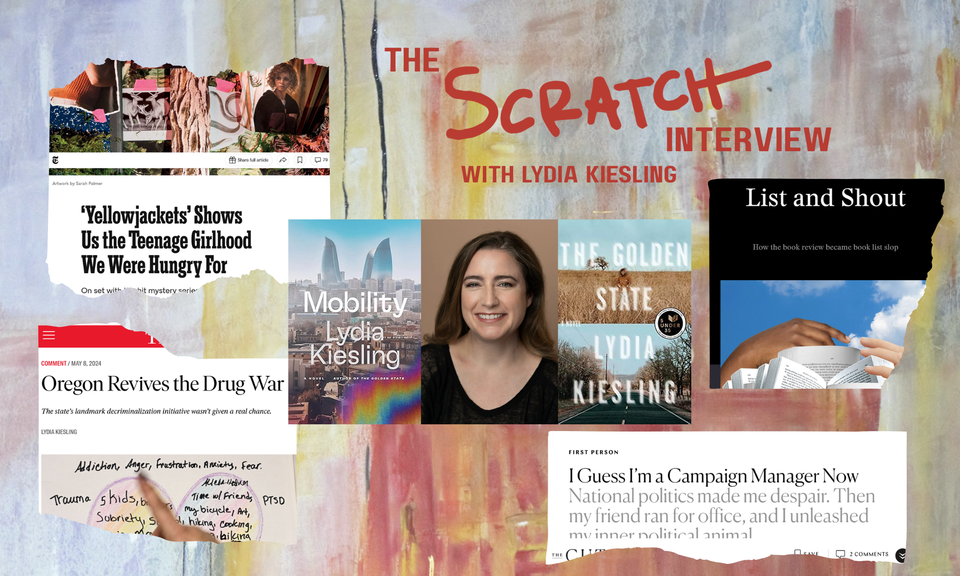
Last spring, Lydia Kiesling was slated to give a keynote address at Sweet Briar College, a women’s college in rural Virginia, after her 2023 novel Mobility was chosen as the Common Read for the year. This meant the school had ordered 500 copies of her book, paid for her to fly out, and provided a not insignificant honorarium — basically an author’s dream. But after doing some research on the school the night before she was supposed to leave, she decided to turn down their offer. Earlier that academic year, a new college president had changed the school’s admission guidelines to exclude trans women. The move had been wildly unpopular with faculty and students alike, and it didn’t sit right with Kiesling.
She mailed back the check for her honorarium and sent a lengthy letter outlining her decision to the college president, after which she was thanked profusely by the Sweet Briar community for speaking up for them. The prior year, Kiesling had taken a writing break to run her friend’s campaign for City Council in Portland, Oregon. Before that, she was instrumental in organizing support for the life-changing measure that brought preschool for all to her Oregon county.
As an alum of a women’s college myself (that is currently being investigated by the Trump administration for including trans women in admissions), an author who has opted out of the corporate world to write books, and a parent who wants to make the world a better place for my own children, I became a deep admirer of Kiesling as a person.
Then I read her books. As soon as I started 2018’s The Golden State, I felt giddy: It was one of the most accurate portrayals of being the crazed parent of a toddler in our terrifying world as I’ve ever read. Kiesling is a master writer and an inspiring human, and I couldn’t raise my hand fast enough when we discussed interviewing her for Scratch.
The following interview has been lightly edited and condensed for clarity.
Maggie Mertens: I actually wanted to start with this thing that happens to me, and I don't know if it's because I'm a parent or a writer or both, but whenever people ask me, ‘What do you do?’ when I’m in parenting mode — at school functions or birthday parties or whatever — I become a deer in headlights. I don't know exactly how to answer that question. So, how do you do it?
Lydia Kiesling: I say, ‘I’m a writer.’ I guess it’s easier now that I have books I can point to. Although sometimes people will ask me, ‘Can I read the books?’ maybe assuming they weren’t really published?
OK clearly this is a confidence thing I need to work on. Can you tell me about your background as a writer? How did you come to write novels and journalism as well, and would your teenage self be surprised at this outcome, or was this your long-term plan?
I think my teenage self would be amazed and astonished. Even though she definitely felt like a writer, deep down, but wasn't really writing. I wrote a lot of stories when I was in elementary school. I started writing a blog [in 2009] when I was about 25 that was about old books I was reading. I was working my way through the Modern Library Top 100 Books in English — which is a silly list, but something to work with — and I had read some of the books already, because I was an English student in college and high school. Those were really the only classes that could sustain my interest. And then after a little while, a bigger book blog asked me to join and move my posts over there.
It sounds so quaint to talk about this now, about the golden age of blogs. I was not thinking of it as something that would earn money or become a career, but it was still a time when you could get editors to find you and ask you to write. I think the first paid thing I did was for Dan Kois at Slate. That felt really exciting. I wrote a book review. So I sort of started to develop more bylines.
I think the only reason I started with [book reviews] is because that was what felt accessible to me. But doing that helped me to think about voice and audience, and eventually I moved into personal essay, because that's what's available to writers, especially women, and especially people writing on the side. I felt there was more of a barrier to entry for things like reported pieces. So I just worked on personal essays, and then thought, ‘Okay, I want to start trying to write a novel.’ I kind of switched over then, but I'm always getting pulled back in the game as a freelancer.
During the time when you were starting the blog, did you still have your job at UC Berkeley?
When I started the blog, I worked for a rare books dealer [in San Francisco]. Previously, I’d split time between him and a consignment retail store, and then I would do these weird side hustle things. Like, someone would work at some tech company that would eventually be acquired by Netflix, and they needed you to do data entry, and so I would try and find stuff like that to do on the side. Then we moved to Pittsburgh from San Francisco because my husband was going to grad school, and so I was a temp at an engineering company and then I went to grad school [in Chicago] from 2010 to 2012. I started working at UC Berkeley in 2013 and that's when I was getting bigger bylines and being able to say, ‘Oh, OK, maybe this writing thing could actually be somewhat remunerative.’ I started to professionalize a bit more, but that's also when I had my first child and realized I couldn’t do all of these things, and I sort of went all in with writing.
I’m really grateful that I was living in a dual income household where someone had health insurance — that part can't be overstated for how important it was — but then also that I had the wherewithal to think that I could do this thing that objectively makes no sense.
Enjoying Scratch? The best way to support our work is with a paid subscription!
Right, it is such a weird thing to look back on. Is that when you were starting your novel?
Yes. I had a conversation with the person who would become my agent, and I heard from her at exactly the time when I was just ready to take a chance [on the novel]. Knowing that there was someone who was interested in reading what I had, once I wrote it, was very important and helpful. That was hugely motivating, especially when I went to my husband to ask, ‘Do you want to mostly economically support us?’ (I did have a part-time web editing job that was way more hours than the $1,000/month I was paid for, but our child care was $1,200 a month.) In order for me to make this negotiation in my household, it was helpful to be able to say, ‘There's a real person who's really good at her job, and she wants to read what I've written.’ I think my husband would have been supportive anyway, but it did help. And then she was the person I showed [the first draft of The Golden State] to, and she said, ‘Okay, I want to represent this.’
Did your agent connect with you because of your online writing: your blogs, Slate pieces, etc.?
Well, actually, the thing that she read was in print. It was for a print magazine that existed I don't think for very long. It was called Stone Cutter, and it was edited by Katie Raissian, who is wonderful. She worked in publishing, [and] she put this little journal together, and somehow my agent saw it, and she read the essay that I wrote, which was about cigarettes, of all things. She wrote to me, thinking that I would maybe be an essayist, and I told her that I was thinking about moving into fiction. So print actually was technically what she saw, but I only got that assignment because of writing online.
How did it feel to move into full-time writing while also experimenting with a new genre, essentially?
I think it felt risky and sort of horrifying. I was very, very scared. After I left my job, which had been a very stressful time, I said, ‘For one week, I'm gonna reorganize the closet and do things around the home that I've been wanting to do, and then [the next week] I'm gonna go to the coffee shop and I'm gonna start writing.’ And I did. I just remember being like, ‘Oh my god. This is horrible. How am I going to do this?’ So, yeah, it felt pretty terrifying.
But now, as I'm getting older and seeing other people's trajectories, I think it's actually very common. There's no way to prepare for writing a novel other than writing the novel. There are people who go to MFA programs where that's kind of the intention — that they'll end with a finished manuscript. But for most people, they're not doing that. They're just kind of deciding one day [that] this is how it's happening.
I was blown away while reading The Golden State by the feeling of self-recognition in your work when it came to the emotions of parenting, especially in the baby/toddler phase. What the narrator describes about parenting a young child was so true for me: that mercurial obsession with your child while also being so bored by trying to find things to do all day. I know you said your first child was young when you wrote that book. Did you set out to write about parenthood/motherhood, or did that just kind of happen because that was the stage of life you were in?
The thing that I first set out to do was to write about the place where my mom grew up, which is in far northeastern California, which I fictionalized in the book; that was really pointless, because I changed almost nothing — just the name. But that was my first thing: how to write about this place, and how I feel about this place. The parenting and caregiving part [came] as soon as I started writing. That was the only thing coming out, and honestly, I could never write that book now. I haven't gone back and read it, and maybe one day I'll be able to do that, but what I remember of it is it's kind of insane. I'm so glad that my brain was like this is what we're writing. I hadn't gotten very far into it before I felt like this is actually what the book is.
I had noted, prior to starting the book, that when I did read something that was about caregiving/motherhood, anything that felt real did feel noteworthy. It was a narrative challenge. I don't think I was thinking of it as a fun narrative challenge at the time, but I was definitely feeling challenged by it. [Namely], these are the things that make up a lot of our daily lives, and they're so important, and they are boring! So if they're boring to experience, they're probably also boring to read about. It was this perverse struggle that I really leaned into once I figured out what I was doing, of how to describe these things.
The other theme that felt relevant in your work to me was about women in the workplace, whether parents or not. How they are navigating these impossible systems of hierarchy in corporate America where they really don’t feel welcome. Were some of those challenges part of the reason you left the more corporate or hierarchical work system?
Yes. I do think anyone who's a 1099 arts worker is thinking about this sometimes — ‘What if I need to go back and get a job?’ I did actually take 2024 off from writing, because I worked as my friend's campaign manager, but that was different than going back to get a job. That happened very organically. So even though the work was difficult, and it was a stressful time, it wasn't the same thing as having to submit a résumé or apply to things.
I think about all the time, like in Scratch, when you guys were discussing the fantasy of being able to get a retail job. There’s the idea that ‘Oh, it would be great to work at Trader Joe's,' but they’re not fucking hiring [Editor's note: probably not great at the moment, though!]. So I have wondered what does my experience actually make me a candidate to do?, and I want to think that because I'm older, and because I have had some kind of professional success in my chosen medium, that I could — this is probably pure fantasy — go and do any of the type of admin jobs that I used to have, because I could say I've asserted myself in my chosen thing, and people have to respect that.
But one of the things that was hard about the admin work is the knowledge that you will never be the subject matter expert; you're going to be the person who helps that person. It’s embarrassing to say this out loud, because it just sounds like you're being a monster. [I mean] why do you have to be the most important person in every workplace? The Golden State talks about this a lot.
But there are venues where I don’t mind that. For example, when I worked for my friend, the City Council candidate, that felt okay, because she’s a woman and we're friends and we know each other, so that dictated what the structure was like. I didn't have a problem that she was my boss: She's doing the thing, and I'm supporting her. Whereas when my boss is some engineer, and I have to support him, and he doesn't listen to me — knowing that I'm never gonna really understand what he's talking about, and I don't care — that feels really hard.
Although now I'm kind of thinking, well, I was just a baby, then. I could do that now. Who gives a shit? I just need to make money. I think I could maybe compartmentalize more.
Even [in those admin] jobs, though, when I felt pride that I was able to execute something in the manner I was supposed to, I was always just thinking, ‘OK, but I want to do my thing, and this is not my thing.’
When young people ask me about becoming a writer, I'm always telling them to get an easy job, and do your easy job, and then write in your spare time. I feel similarly that I regret leaving my easy-but-boring, admin-adjacent job that I didn’t care about in my twenties, even though I hated it, because I felt like I wasn't doing my thing. But now I wonder if I could have given myself more financial security (and also the brain space to write whatever I wanted) had I stayed. Maybe that’s just idealistic thinking . . .
That is a fantasy, because also when you think about it, there are very few jobs where it's purely some sort of clerical process that's unchanging, and that does not require being part of the broader currents of whatever happens in the workplace. If there is that job, it's rapidly being automated by some generative AI thing.
Any job, even the jobs that you think of as easy — say you just have to proofread the reports — you're never just doing that, because all these other things are happening. Something's always getting reorganized because a new person came in and wanted to change everything, and Deborah has all the institutional knowledge, and you've got to figure that out with her, but she hates this other person. I do think there are jobs that follow you home more than others. That’s the thing. It may still be possible to find a job that doesn't follow you home quite as much. I think I let jobs follow me home even when I didn't have to, and that's the other problem.
That’s really hard even when you work for yourself. You have to set those boundaries about letting things eat into your personal time. As a fellow person trying to do too many things — parenting, writing, being a community member in this hellscape — how do you actually do all of the things?
I mean . . . I don't. And with writing, I've found I'm not making big progress on fiction unless I go away from my house and say, ‘I am now going into isolation.’ The longest time I've done that for, so far, is six nights, which I did last month. But this was the year after I finished the campaign work, and I thought that if I don't want to find myself in these situations of suddenly having a job that's not writing, I have to really make a commitment and take it seriously, and understand that it's not an accidental thing. And likewise, it's intentional when I’m just not doing it, and I’m self-sabotaging.
This year I applied to all the things, which I haven't done in the past, and I got one great grant that really made a big difference and helped confirm ‘This is why you have to apply to the things!’ I'm waitlisted for a couple of residencies, and I've gotten into one that will be two weeks; that will be my longest residency.
So just throw your hat in the ring for these things, even though it is very competitive. I have been doing this long enough that I sort of have to have a little deluded self-confidence. [This] is what professional writers do. They apply for grants, and they try to get residencies. So I'm trying to do that, and of course I've spent $600 on these applications. I could have gone to a Marriott for two nights with this money.
Elsewhere, I'm trying to step back a little bit from some of the community obligations that I have. Part of doing that work is you sort of realize it's never-ending, and that's okay, and that's the point. I don't want to do the thing where you’re trying to do everything, and then completely burn out and disappear, because that's not helpful to anybody. But also just understanding that there are rhythms and seasons to this, and I’m entering a season of tagging out a little bit, so I can finish my book. Because also, the thing that I've been trying to tell myself is that the novel I'm working on is about some of that community work.
Sometimes it can feel hard to justify why I'm writing about ideas versus actually doing something, but the ideas are also important. Reading other people's ideas helps me see more clearly what I want to be doing and helps me sharpen my own commitments. I'm trying to tell myself it's okay. It is not possible to be fully on the ground, trying to do all the things, while also doing the very slow work of trying to come up with a story that incorporates those ideas well, and also parenting. Let me not forget my actual children, although they probably do feel like they get sort of forgotten. They're always like, 'Mommy has a meeting.'
Yes. I hear that a lot, too.
They can write their own books when they're older, I guess.
Can you talk to me just generally about what your financial situation as a writer is now? In terms of your books providing income, or what your main streams of income are these days.
So I've been very lucky that I got large advances for my books. My agent will get mad at me when I say, ‘I’ve been very overpaid for my books.’ She says, ‘Honey, I see a lot more people getting more money.’ But I was lucky that I got what Publishers Marketplace calls a ‘good deal’ for both of my books. I got less money for my second book than my first book, which is fine. It was still plenty. But as your Scratch readers know, [that payment is] split over three, sometimes four years, and then there's your agent fee and taxes.
The last money I got for Mobility was when my paperback came out, which was in 2024, so I got $31,875 from that. I also worked as a campaign manager in 2024, so after taxes, I made maybe $50k that year. But then in 2025 I did almost no paid writing, with very tiny freelance things, and maybe got $300. I did get a big artist grant, which was $25,000, which was incredibly significant, but I'm also really good at writing things off [on my taxes].
When I got the artist grant, I had a ton of credit card debt, and I instantly spent the money on that, but then I was like, ‘Now that I've been paid to be an artist, I must support other artists.’ So I bought all these books, and I subscribed to all these magazines that I will never read, because I felt I must single-handedly prop up our media economy, so now I'm in credit card debt again. The upshot is that I managed to net $0 Schedule C-wise.
This year, I am writing a nonfiction book about Portland for a European publisher who wants city guides written by novelists. So that's some money. I wrote an essay for The Cut, and I got paid $1,200 bucks for that.
I had a book come out in 2018 and a book come out in 2023, so over an eight year period, I've probably averaged $30k to $40k a year that I'm bringing in. But then some years there's been no money, and then others there's been more, which is very hard to plan around. I don't file quarterly taxes because I can't figure that out, and I never have any money. I'm always waiting on a miracle to be able to pay the taxes that I owe next year. I sort of assume that something will happen that will make it work, and so far, knock on wood, it’s kind of balanced out. But my penalty has never been very high for not paying quarterly taxes.
I have a very similar financial strategy. I just put everything on my credit card, and hope the next assignment comes in, and try to write as much off as possible. It sounds insane to people with normal jobs, but it’s worked fine so far, and hopefully my kids don’t need horribly expensive orthodontia or something?
I don't know what they want artists to do. The write-offs are the one thing that we get, and we pay a higher tax rate than anyone, but I challenge the IRS to ask me how my pile of books is not relevant to my work. I will show them the exact line in my novel and be like . . . and that's where they went to this place, which I went to and wrote off.
What was your financial life like while growing up? Do you ever think about whether you want the same or different things for your kids in terms of financial stability or that kind of world for them?
I was a Foreign Service brat. My dad worked for the State Department, and I moved around a lot. That's an interesting job, because it's sort of inherently fancy. It’s a job with prestige associated with it, and then there are benefits that accrue that also compound the eliteness of it. I went to a boarding school for high school, which I would not have gone to had the federal government not paid for it. That is one of the benefits of overseas work, and so that kind of catapulted me, in a way, into a different [world].
I met people there that were just so rich. But it was a great job that my dad had, and my mom also had to work around that life, which was very totalizing (the constant moving). I had a comfortable upbringing that had a lot of privilege in the form of tangible things but also the intangibles; I was able to visit a lot of places. Of course, there are also challenges to that type of life, but they're not material challenges in any way.
It’s funny because my husband has worked at public sector jobs, and has always had jobs that have great benefits, and those are the types of jobs that actually [are comparable to] what a State Department salary could look like. But what you are able to do with that salary is much different now than it was when I was growing up.
When I talk to my kids, I say, 'This is the day that dad gets paid, because he gets paid every two weeks, just like in Ramona Quimby.’ I feel kind of weird about it, because then my daughter will be like, ‘We can’t do anything 'til Daddy gets paid.’ And I mean, no — I have a credit card. There’s a way in which I don't consider that we live paycheck to paycheck, because we have access to things like very easy credit, and because I have this job that sometimes involves a windfall, but sometimes doesn't. But the reality is that's when I do the grocery shopping — on payday — because that's when we have cash, and I'm not going to put that on a credit card [if possible].
I think my kids are just gonna have such skewed ideas about everything, because I'll say, ‘You have a perfect life. You have never suffered.’ And they'll say, ‘But you don't go to the grocery store until it's payday.’ And honestly, yeah, that’s true.
Correction: We initially reported that Lydia received $38,000 from Mobility's paperback release. It was actually $31,875 after her agent's fee on a payout of $37,500.
This interview was edited by Rahawa Haile.
Scratch is a weekly newsletter about how your favorite writers are surviving (or not). We are a four-person collective publishing essays, interviews with other writers, and topical inquiries into the publishing and media industries today. If you like what we’re doing here and want to support us, a paid subscription is the best way to do so.
Become a free subscriber to receive our weekly newsletter.
Member discussion