The Scratch Interview #8: Deesha Philyaw on Committing the Cardinal Sins of Publishing, Part I
“So despite short stories ‘not selling,’ I just found other things so that I could keep writing my short stories.”
Welcome back to Scratch!
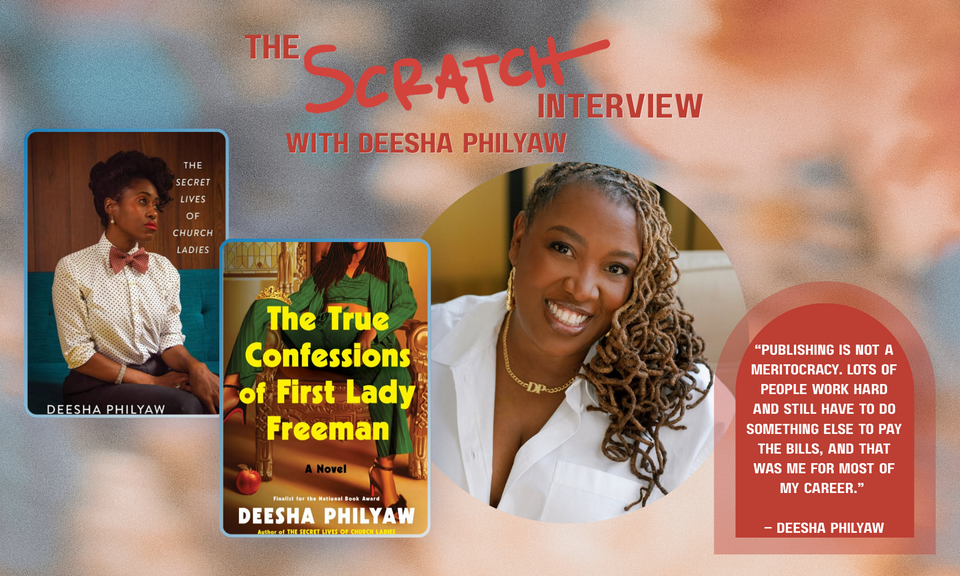
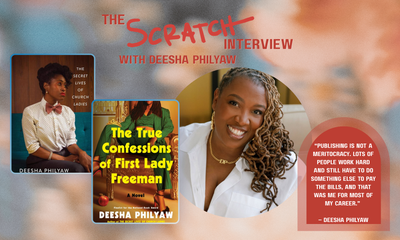
We've returned well-rested after taking two weeks off from publishing, and we come bearing a special treat: a two-part interview with the one and only Deesha Philyaw, whose first novel, The True Confessions of First Lady Freeman is out Sept. 29 from HarperCollins. (Pre-order at the link!)
AND we're introducing something we’re really excited about: THE SCRATCH MAILBAG! Do you have questions about writing, publishing, media, and survival? Ha, we know you do!! Click here and scroll down to "Mailbag" for instructions on how to send us your most burning qs.
We want Scratch to be a place where writers can find support, community, catharsis, and genuinely useful information; this is one of the steps we're taking toward that end.
Now, on to Latria and Deesha.
— The Scratch Team
Rahawa recommended that I read Deesha Philyaw’s The Secret Lives of Church Ladies not long after its publication in 2020, and I remember spending that first COVID-tinged Thanksgiving in the company of the women in these short stories. In the pages of that slim volume, I watched Deesha put elements of the church-going Southern Black woman's experience on the page. Her characters told me of my own secrets, things I couldn't even admit to myself. Rahawa and I weren’t alone in our fandom. The collection, published by a small academic press, won the 2021 PEN/Faulkner Award for Fiction, the 2020/2021 Story Prize, and the 2020 Los Angeles Times Book Prize, and was a Finalist for the 2020 National Book Award for Fiction.
Deesha and I now share an editor, Rakia Clark at the Mariner imprint of HarperCollins, but we first met IRL at a writer’s residency back in 2024 in New Smyrna Beach, Florida. Our careers permit us to crisscross the country talking about stories, and that means we cross paths a couple of times a year, usually in the South (I’m from South Carolina and Deesha’s from Jacksonville, FL).
I learn so much from Deesha every time we connect. Whether it’s a conversation about the psychological highs and lows of the creative process or financial quagmires that come with an unwavering commitment to the craft, I’m always floored by her candid revelations about living the writer’s life, and generosity towards emerging writers.
I spoke with Deesha by phone from her home in Miami ahead of the release of her debut novel. Our discussion produced so much fantastic material that we're delivering it to you in two parts. Today's installment is about Deesha's career path and how she survived as a fiction writer, and tomorrow's will focus on how she builds, serves, and depends on the literary community.
The following interview has been lightly edited for length and clarity.
*Note: This post contains Bookshop.org affiliate links. Purchases made through them directly support independent bookshops and help keep Scratch running.
Latria Graham: Your debut novel, The True Confessions of First Lady Freeman, is *everywhere* right now. The level of storytelling skill that you demonstrated in your debut story collection The Secret Lives of Church Ladies takes a long time to refine. Still, I was shocked to hear you started working on elements of this novel almost twenty years ago. Can you talk a little bit about the early days of your relationship with writing?
Deesha Philyaw: Writing the stories and just writing in general, for me, that predates Twitter, that's sort of early 2000s. And I initially wanted to write a novel because that's the impulse—if you want to write fiction, you think books. I don't have an MFA. When I started writing, I don't think I knew what an MFA even was. I felt like learning to become a better writer was something I could do with the things that were at my disposal.
So I read a lot of craft books, went to writer's retreats and conferences and took community writing classes and workshops—things like that. The very first workshop I ever took, I think I was pregnant… so that would've been in the late '90s. It was a flash fiction class. Even though I wanted to write a novel, that's what was offered, so that's what I took. I did not know how to write succinctly, and the skill of telling a whole story in this compact form, was a skill that I did not have. I worked at it, but it was at least a decade before I ever wrote good flash.
I attempted a couple of different novels and started workshopping some things. Short stories kind of crept in because I also got it into my head, as a lot of beginning writers do, that getting published was the thing that was going to make me a real writer. So I started responding to calls for submissions, which were typically for short stories. So I was trying my hand at the form and getting rejected, as one does. But I was spending probably as much time doing these stories as I was with the novels, which kind of fell by the wayside.
In 2005, I decided that I was going to pursue writing as a career because I got divorced and it was like, I need money. I had been a stay-at-home mom. I had to get serious about this.
And writing that way is a *totally* different thing.
Yes, and there were more opportunities to write non-fiction, whether that was personal essays, specifically writing about parenting, book reviews and things like that. So I was writing pretty much a little bit of everything and the novel was on the back burner. I had a parenting column at Literary Mama, and I did that for four years. I was getting some national newspaper and magazine credits by writing book and film reviews as well as some essays. I always called it a patchwork quilt of income from different types of writing. I wrote a co-parenting book with my ex-husband, which is how I landed my agent, Danielle Chiotti. She's a very strategic thinker and she's always talking big picture and what's next. This was back in 2011, and we both lived in Pittsburgh. She was always reading things before I sent them out, and she would also attend events in the community.
I told her about this novel that I had been working on for about five years. It wasn't called True Confessions at the time. When we were done with the co-parenting book she was like, "Okay, let's talk about this novel." I was stalled, but she would never let me give up on it. We would meet periodically to talk about it. And she gave me some really good advice and some resources on how to get unstuck. And I was sort of inching along with it, but at the same time, I was still responding to calls for submissions and writing short stories.
If I was invited to do a reading, she would come. So she read and heard these short stories. Around 2016 or so, she said, "While you're on hiatus from this novel," which was a very generous take of what was happening there, "maybe you could get intentional about these church lady stories." So she called them that first, and they were about Black women, sex, and the Black church. And so she said, "If you got really intentional about that, maybe you could build a whole collection." That was the first cardinal sin of publishing that she convinced me to commit, which was to aim to publish a short story collection first and not a novel. Then she said, "If you can get three of these stories published, we can go to market and go out on submission with a partial manuscript," which is the second cardinal sin of publishing and submission, which is you do not go to market with a partial if you are trying to debut, especially if it’s a short story collection.
Ignorance is bliss because I didn't know these were cardinal sins that we were committing. I just knew that I was stalled on the novel, and I knew that what she was proposing sounded more doable. I had had work published in anthologies. When Church Ladies went out on submission as a partial manuscript with six stories. It got rejected everywhere except for West Virginia University Press, so we took that offer. That was in 2019, and the book came out in 2020.
When I submitted that manuscript to the publisher, I just felt like I was ready to write this novel. I felt more confident. There was still a ton of work to be done. Most of everything I had written prior to that point, I scrapped. The tone of the book changed. It became satirical. The character was different. Her name changed. But then I spent the next three-and-a-half years working on it. We went out on submission in summer of 2023 — again with a partial manuscript. We wanted to take advantage of the momentum of Church Ladies, which I mean at that point it had been three years, so we were really pushing it. But we just felt like I had gotten to a good stopping point in the book and my agent felt confident that it could sell.
Enjoying Scratch? The best way to support our work is with a paid subscription!
Did the popularity of Church Ladies catch you by surprise?
It was when my friend Kiese Laymon was a guest on Traci Thomas's podcast, “The Stacks,” that things took off. She asked him what he was reading or what he was looking forward to or something like that, and he mentioned my book. My social media drug of choice had been Facebook and Twitter, not really Instagram… I had an account, but I wasn't active. I thought, let me get back on Instagram because I'm going to need to promote this book. When I got on Instagram, I see where Black bookstagrammers, book influencers had been tagging me and saying, "Lady, we don't know who you are, but Kiese said read your book, so we're going to read it."
That just shows just the strength and the power of community, of speaking each other's names in rooms, be they virtual or real, and how that our trust and our reputation carries so much weight. So these people didn't know me from Adam, but they knew Kiese and they knew his work and they trusted him enough to be curious about this lady they don't know and her short stories.
So many people said and continue to say, "I don't like short stories. I don't read short stories." But they were willing to give my collection a chance, and I just appreciate that so much. And so that's when I got the kind of first inkling that, oh, this book might actually reach the people that I hoped it would reach. I wanted to reach lots of people, but in particular, I wanted it to be people who had experiences with the Black church who were still trying to get free of those things that maybe they left the church physically, but the church doesn't always leave you mentally.
And that’s huge because there’s a bit of…prejudice I think at times against short stories, even though I’m not totally sure why. What do you love about the short story, either writing it or reading it?
So it really is a chicken or egg question, I think, in terms of: is there less demand for short stories because publishers don't value them as much as they value novels and don't seek to publish them? Or is it the other way around: publishers aren't interested in publishing short stories because there's no demand for them? I think that it's a combination of both.
I think we are taught in school, many of us, that the short story is a lesser form. For most of us in Gen X, our introduction and maybe our only exposure to short stories was in school. Short stories were framed as these little things you read in language arts class or English class, but we were told the real meat of intellectual inquiry came when you read a novel.
So we have to advocate to try and change that narrative. That's one of the things that Dawnie Walton, Mark Armstrong, and I try to do with Ursa Short Fiction, our podcast that is dedicated just to short fiction. So few things are dedicated just to short fiction.
Nonfiction is one thing, but when writing is a career and way of making money, particularly now that you’re all in on fiction, how do you think about the economics and money-making part of it?
There's lots of things about this industry that are battles that are worth fighting, but trying to insist that you get paid your worth…literally no one in this business is getting paid their worth. Early on I kind of accepted the low rates on their terms. And this is over the span of a 20-plus year career. So before the 2008 collapse, I was writing things and getting paid $2 a word by national magazines. That is unheard of now. When that changed, it was like I can either accept a lower rate or I can go kick rocks. You can't argue with publishers or with editors.
Publishing is not a meritocracy. Lots of people work hard and still have to do something else to pay the bills, and that was me for most of my career. So despite short stories “not selling,” I just found other things so that I could keep writing my short stories. For a while I was a fact checker and copywriter at BET for the BET Awards and the Hip Hop Awards. I did that for four years. I made pretty good money, but it was a contract, so there was no health insurance. I took on projects with nonprofits. For a time, the City of Trenton was a client. I have a friend…everywhere she worked, I had work. She would throw a contract my way or a project my way, a speech my way, whatever it was. For three years I did try to do corporate communications. I was like, "I need a steady paycheck and I need health insurance." I survived three years before I walked out of that bitch. Otherwise, I was always doing multiple things. I was taking individual editing and book coaching clients.
Something I want to make sure I say is part of how we artists survive this is being in community, helping each other out. There was a time for almost a year where another artist friend of mine paid my rent.
And I had no idea how long she would be able to do that or whatever, but it certainly helped with the transition to leaving that corporate job. There were times when…I remember I had to buy some bread and all I had was nickels. I made a note to myself to remember that there's going to come a time where it's not going to be like this, that it hasn't always been like this, but this moment matters because this too is part of the sacrifice and the uncertainty of choosing this particular profession. There's highs and lows.
Speaking of highs, what was it like to transition from West Virginia University Press to HarperCollins? How did it change your understanding of book publishing? Your deal was so public when it was announced.
First, I want to talk about me being okay with the money being public because there are a couple of concerns. Again, we were taught not to be ashamed of having money, but you're not supposed to talk about money, religion, or politics or whatever. And that only protects people who are benefiting from the exploitation of other people. And so after #PublishingPaidMe and we realized how our most cherished Black writers like Roxane Gay were being paid compared to far lesser known writers who were white, it was like that can only happen because we're not talking about it. And so when I announce my big deal and other writers of color and other marginalized writers do, I hope that it encourages other writers to push and to have their agents think big. Their deals may not be seven figures or whatever, but it's not unheard of. Folks need to know it is possible.
I’ve seen the benefits because I've had other Black writers tell me what they were offered for different things because there are other book projects I'm working on and everyone’s trying to figure out what a “good” offer looks like. My agent knows and I trust her. I also talk to other writers and get their perspectives, because all of it sounds like a lot of money to me. So I had no qualms about sharing it for that reason because I think that hiding it only protects publishing. It does not help writers.
I know Kiese [Laymon], for example, when he won the MacArthur Genius Prize and also when they announced his seven-figure deal … he was not necessarily thrilled about that because it brought everybody out the woodworks expecting him to give them things. So I was prepared that people might make assumptions about and feel entitled to me giving them things, but I don't have a problem saying no. The other risk I knew that came with the announcement was people thinking my writing didn’t deserve it or whatever. And that's a them problem. I don't care. I really don't care about that stuff.
How do you get to that point? I’m notoriously thin-skinned!
I think some of it for me has just been…a lifelong process of not worrying about what people think. My mother was very loving, very devoted, but she was also super critical of me and made me incredibly self-conscious growing up and into my adulthood.
Once I was in my 30s, I just had this realization that I'm over here trying to figure out my kids, my life, my writing, this marriage that I don't want to be in anymore. All of this stuff. And I had thought about how little I thought about other people. And then a light bulb went off and I was like, "they're all concerned about their shit, so they're probably not thinking about me either." That was so freeing.
I think another turning point was in 2005, my mother, my father, and my grandmother all died and I got divorced and I'm raising kids and co-parenting and all of the things. And it sounds so cliché, but that whole thing about how life is too short, suddenly that was real. And the things I started worrying about were big things. The smaller things about somebody not liking me… I don't have the energy.
When it comes to writing rejections, again, ignorance is bliss.
A lot of what people are upset about around rejection happens because there are more people who want to publish books than there can be books published. So once you realize that lots of great books don't get published or that those books don't win awards because there's only so many awards, you disconnect the outcomes from how you feel about yourself. That was it for me. I had been doing so much work on how I feel about myself, how I feel about my body, how I feel about my life, and who I am and the kind of person I am, the kind of friend, the kind of partner, the kind of mother. None of that is tied to whether or not someone publishes my work. That's a whole separate thing. But I think what happens is people believe getting published is going to make them feel complete. It helped that I read Anne Lamott years ago [in Bird by Bird] when she writes that publishing will make you "probably end up even more mentally ill and full of stress and self-doubt than you already are." And I was like, "Well damn."
She did a lot of people a service with that.
I tell people if you're doing all of this because you think that this is the thing that's going to heal that wound that came from your parents or came from your tragic marriage or whatever, it's just not. The work is the work and it can make a difference. I'm happy. My work makes me happy. I don't want to do anything else. But I can't say that getting a seven-figure deal is the thing that made me happy and that I was going to be depressed if I didn't get that. I'm old. I'm 54, so I've had a lot of years to figure this shit out. Which is why I'm not too upset that my first book of fiction came out when I was 49, because I don't think I could have handled it at 29. Because I think I was still very much externally, extrinsically motivated. I still needed people to like me at that time.
And I would definitely have mixed up accolades for the book with accolades for me. And so if there weren’t accolades for the book, then I was going to be devastated.
But that doesn't mean that I'm not disappointed when things don't work out. I've gotten rejections since Church Ladies came out. I've gotten rejections since getting a seven-figure deal. Other than Atlantic Center for the Arts, which we did together, and Baldwin for the Arts, every other residency I've ever applied for, I got rejected.
My mouth is open. That's what that sharp inhale was.
See what I mean? This business is fickle. It's subjective. There are no guarantees. You will drive yourself crazy if you try and figure out the why. The why is: I just didn't get it. Who knows? It could have been the judges. It could have been the timing. It could have been who else was applying. It could be a bunch of things that I'll never know. So I'm going to try not to drive myself crazy thinking about things that I can never know.
Are there other projects that you're working on right now? I know there’s another short story collection coming, too. And you have podcasting, you've got TV, you have so many plates spinning. How do you decide what you would like to do?
So yes, the short story collection is titled Girl Look. And I do not know when that's coming out. It'll be sometime after the paperback for True Confessions. That's all I know. I'm also working on another novel. And I've had a concept and a few pages written for a YA novel that I would love to publish someday. And while the TV adaptation of Church Ladies is on the back burner for right now, we still are hoping that that will see the light of day in some incarnation. But I am currently working on a script for the TV adaptation for a story I wrote called “Fuckboy Museum.”
Okay. It still lives. Amen.
It still lives. It's gone through some changes, but there's some interest, and so we're working through that process. And then True Confessions, there is some interest in adapting it, but nothing has been formalized yet, so there's nothing I can announce at this moment, but that's also something that I am hoping will come to fruition as an adaptation.
I'm going to keep my fingers crossed because I think you know this. I never ask my friends how the work is going because that makes me want to jump off a bridge. So I was never going to ask about the adaptation of “Fuckboy Museum.”
I don’t mind you asking because something not being done is not a failure. It's just not time. Church Ladies, we had a big announcement with Tessa Thompson and all of that, and we worked on it for five years and HBO just said one day, “No, we're not going to make it. We're not going to green light it.” We wrote two whole episodes and all the notes and the revising and it was a lot of work. But I got paid. And again, so see, I think that's some of that shame stuff that says if we haven't finished something or if it doesn't get finished in a certain amount of time it doesn't mean anything about me as a person or a writer. It just means Hollywood decided not to make my shit.
And so it's a question of do you keep showing up for the uncertainty? And my thing is, sure, why not? It's something I'm interested in. I'd love to see it, but it's not like if this doesn't happen, I'm going to feel like a failure. I'm going to be disappointed, but each time I get back in the saddle with Hollywood, I'm open. I'm just open. I've figured out how it works. And it's that nothing is promised and everything is a damn crapshoot. I'm still hoping that these things will happen.
But mainly the thing is I want to be able to retire at some point. And I would like to have money to retire on and to have good healthcare. I'd like to leave this country. And so I want to continue to — whether it's writing books or writing TV shows, whatever it is — I want to keep doing that so that at the end of my life, I'm not worse off than I am now. So that's my goal.
The accolades and that kind of stuff, they serve that in that the more accolades I can get, the more success I can have in these external ways, which allows me to keep doing this so that I can be safe and comfortable. I don't expect my children to take care of me. I don't have a partner to take care of me. I'm all I got. And so this is what I'm trying to do for myself and for my future. And so it's tied up in that, not in my ego or how I feel about myself or anything like that.
Part 2 of this interview, on how Deesha Philyaw views and serves literary community, will arrive in your inboxes tomorrow.
This interview was edited by Maggie Mertens.
Scratch is a weekly newsletter about how your favorite writers are surviving (or not). We are a four-person collective publishing essays, interviews with other writers, and topical inquiries into the publishing and media industries today. If you like what we’re doing here and want to support us, a paid subscription is the best way to do so.
Become a free subscriber to receive our weekly newsletter.
Member discussion