
Legacy Media Wants to Hire You (No, Not You)
Not me either, but that's OK.


Welcome to week six of Summer Scratch!
Today, we’re sharing Rahawa's essay about what recent job listings for writers and editors reveal about our binary employment landscape.
Perhaps you’ve heard the latest US jobs report is bad. How bad? The National Women’s Law Center wrote that of the reportedly 23,000 jobs shed “[w]omen accounted for 100 percent of the decline in the labor force in July.” The Bureau of Labor Statistics also revised its June and May numbers down by over 100,000 jobs combined. And since the start of the year, more than twice as many women have exited the workforce as men. (Some more than others, as with 2025.)
Readers of Scratch know that things have been tough for workers in media, publishing, academia, and the arts at-large for some time now; this publication is nothing if not clear on its reason for existing. I’d also like to think there’s enough history behind us to understand what the targeted destruction of these industries, which focus on the production of knowledge and culture, does to bolster the infrastructures of fascism. The AI-poisoned well of our current information ecosystem doesn’t help matters much either.
These are, to put it mildly, desperate fucking times.
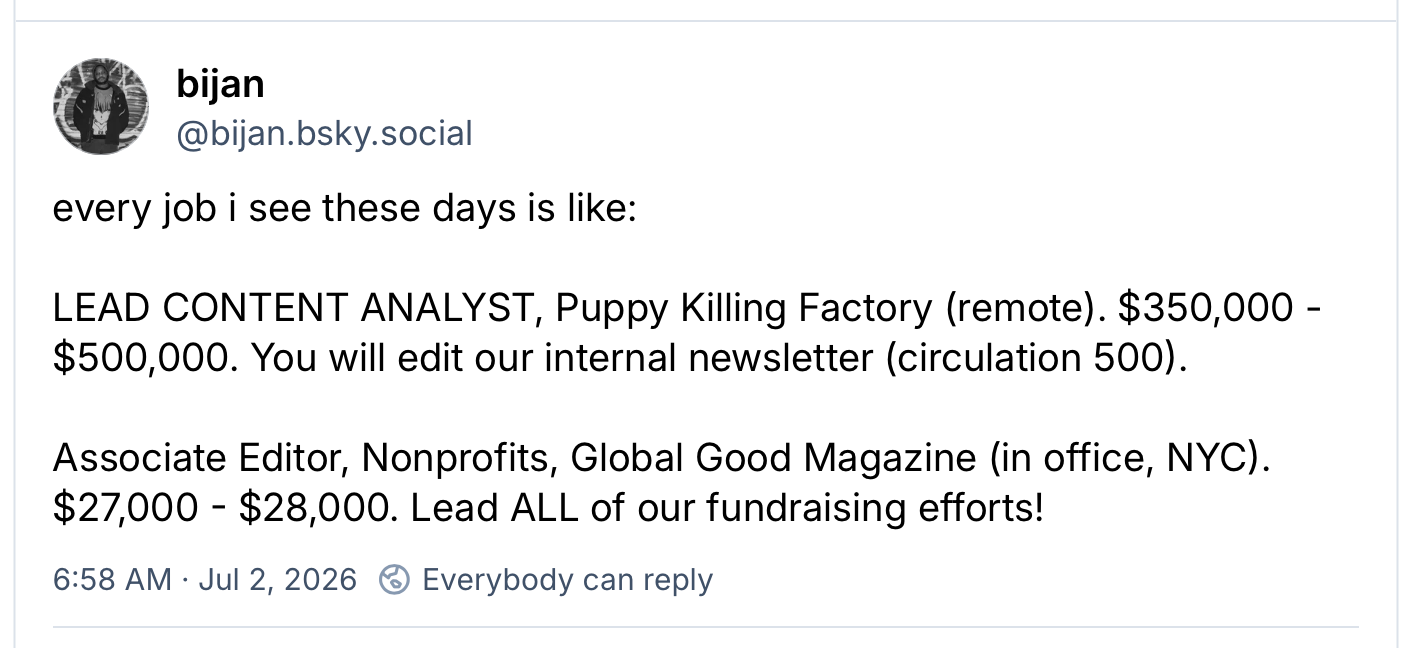
This summer, the AI company Anthropic posted a widely derided job opening on its Editorial Publishing team. The listed salary range was $295k-345k. “You'll write, edit and commission essays, explainers, and profiles for a curious general audience—pieces that take a research finding, the building of a new product feature, or a debate happening inside the company and make it legible and interesting to a general readership” read the posting.
On Bluesky, many writers scoffed at the thought of selling one’s soul to a company actively destroying writers’ ability to make a living. Besides, similar jobs had made the rounds in the past—OpenAI offered nearly $400k for a content strategist position just last year. “Think of these roles as being a Substacker within Anthropic,” wrote the company’s chief communications officer on X in November, referring at the time to a pair of openings within the company. “These roles are for big thinkers and domain experts, not content marketers.”
I’m sure they are. I’m sure the writers in these positions have done whatever calculus is necessary in order to live with themselves, as I’m sure many journalists in the books/publishing space are doing right now.
Enjoying Scratch? The best way to support our work is with a paid subscription!
Last week, The Atlantic shared a job posting for a senior editor to “build and lead The Atlantic Book Club, our forthcoming membership-exclusive reading program,” for a maximum salary of $180k. The person hired will, in theory, “select and champion each Book Club title, making and defending choices that reflect The Atlantic's intellectual rigor and editorial ambitions, with a capacious and highly creative view of which books should be read (or reread) in a given moment.”
As a business decision, it makes sense—book clubs are in, coverage is grim, and publicists are starved for outlets. Former US representative Katie Porter recently announced she’s leaving politics to become a book influencer, while former President Barack Obama is launching a books podcast next month. For better or worse, the gutted books sections of legacy magazines are primed for a revival, however concentrated. And cultural cachet matters when your industry’s being propped up by users in it for the games and cooking bundles. I’ve no doubt publishers will be fighting tooth and nail to place upcoming titles with whomever lands this gig.
But… have you read The Atlantic? Like, this decade? That Atlantic? Champion of transphobes and racists? Home to Jonathan Chait? David Frum? Conor Friedersdorf? Helen Lewis? (I won’t even try to bring up Gaza.) What books might reflect that “intellectual rigor and editorial ambition,” I wonder. Abundance?
I know exactly the type of person The Atlantic has in mind for the position; I suspect you do too. I believe we can leave it at that.
And again, a part of me gets why people would apply. There are talented writers at the magazine! Particularly in its culture section! People need health insurance! And OK, fair enough. But if you want to be an employed journalist—at the best-resourced publications with the biggest reach—it increasingly feels like you’d better get ready to throw your ethical qualms out the door or pack up your laptop and leave.
The New York Times, as it so happens, is also hiring a book editor. The book editor, in fact, to oversee its Books desk. The pay range is $200k–225k, and it’s certainly a dream gig for anyone who can stomach joining The New York Times in 2026, which I recognize is thousands of folks. Whoever they are, I genuinely hope they’re great. For a decade, the bar was in hell. Its most recent editor, Gilbert Cruz, is apparently transitioning into what sounds like a list-shaping role as “canon editor” (for whatever gobs of money that entails), whose product will likely rely on unpaid crowdsourcing from literary experts in their subfields. I can only imagine the NYT’s goal is definitive branding as the arbiter of historical excellence.
Which brings me back to Anthropic: The gap between what the AI companies are shelling out eye-watering sums of money for and what The Atlantic and NYT hope to accomplish feels exceedingly small. We live in a world where there exist a few exceptionally well-paying jobs to develop a brand voice on one hand and writers earning pennies on the other; there is no spectrum. There’s the $200k job to run the Books desk or the $600 a friend got paid in 2024 to write a book review for the Times before taxes.
All told, it is a terrifyingly short leap from normalizing the expectation that writers should barely make money—whether that involves tiny payouts for the blatant theft of their work or pitiful compensation due to devalued labor—to not paying writers at all. Just ask musicians.
On Saturday night I streamed a dystopian film called The Long Walk, adapted from one of Stephen King’s novels, and could not help but think of these job postings. In the movie, a group of 50 impoverished boys, one from each US state, enter a competition in which they must walk until they physically can’t any longer, all for the chance of winning unfathomable riches; those who stop are shot dead. Only one can claim the prize. The novel may have been a metaphor for the Vietnam War in the 1970s, but in 2026, the film more closely resembles the capitalist rat race of a gig economy that's expanding at breathtaking speeds.
There’s got to be a better path forward for writers that doesn’t involve dying to live in hopes of getting lucky.
This essay was edited by Maggie Mertens.


Scratch is a weekly newsletter about how your favorite writers are surviving (or not). We are a four-person collective publishing essays, interviews with other writers, and topical inquiries into the publishing and media industries today. If you like what we’re doing here and want to support us, a paid subscription is the best way to do so.
Become a free subscriber to receive our weekly newsletter.




Member discussion