What We're Reading This Season
Or whatever else you want, really. No judgement from us.
Welcome to week three of Summer Scratch!
This publication is all about shedding light on how writers are surviving the rapid declines of our industries, a rise in fascism and censorship, and the broader need for community and celebration. We’re proud of this work, but we’re taking the opportunity to loosen things up a little this summer.
The next month or so will feature a somewhat more playful (and possibly experimental!) Scratch in your inbox.
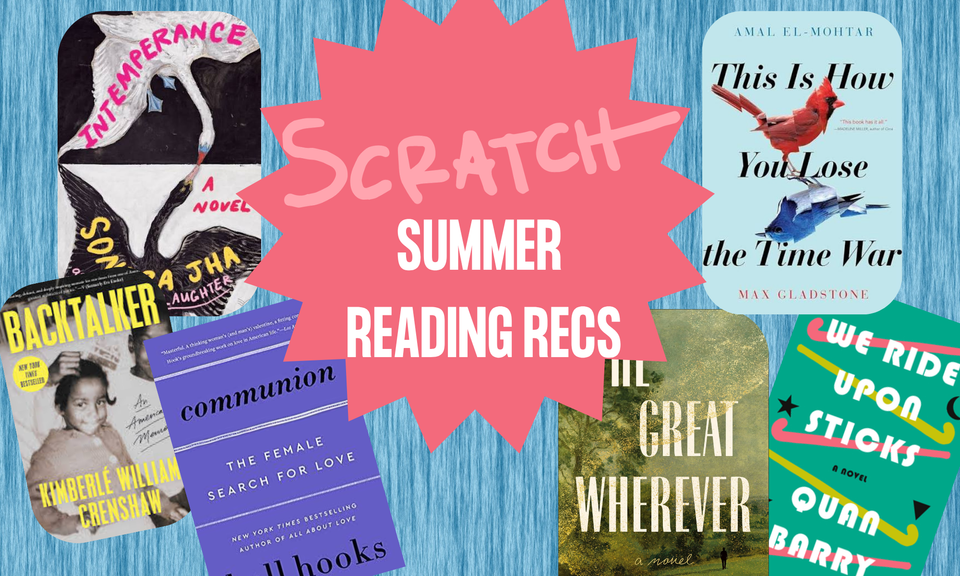
Today, we’re sharing some of the books we've been reading and our respective approaches to summer texts.
— Manjula, Maggie, Latria, and Rahawa
* * *
Note: This post contains Bookshop.org affiliate links. Purchases made through them directly support independent bookshops and help keep Scratch running.
Manjula Martin:
This debut is as good as everyone is saying it is — a fact which is not only satisfying to me as a reader but deeply refreshing to me as a person who daily complains that whenever I actually sit down and read whichever contemporary novel everyone (by which I mean, book people) is gushing over, I’m like… Meh? And then I get mad.
The Hill made me mad at the systems it portrays, the histories it struggles with, and oftentimes the very flawed and real, loving, alive characters whom it portrays. It also made me mad that I don’t live in an artistic economy that provides room for authors to take our time writing the book we need and must write, because on the rare occasion that does happen, we get a book like The Hill.
I’m not even going to try to summarize the novel’s premise here, because it sounds so much more ripped-from-the-headlines than it reads. Plus, I’m sure Terri Gross will do that for me. And forget the marketing-friendly fact that it took Clark twenty years to write the book. You’d never know: The story feels fresh, the language free of bloat, the humor wry and of a distinctly, lovably New York flavor. I won’t say it’s fun to read, but it’s pleasurable in the way good novels are — and perhaps as much fun as one can have reading a work of fiction that is largely concerned with the hold that the carceral state has on the American soul. I am going on record now as saying it is going to win All The Things (by which I mean awards, etc.) and deservedly so. Grace Paley would be proud.
On the non-Fresh Air circuit, I learned about this tragically underhyped novel from my buddy Tessa Hulls (whose graphic memoir Feeding Ghosts I predicted would win All The Things, and it sure did!). Intemperance is a deeply enjoyable novel whose protagonist is an unnamed, 55-year-old, twice-divorced, disabled Indian immigrant to Seattle who works as a women’s studies professor.
When she decides she is ready for a relationship, she somewhat inexplicably (menopause, it’s wild!) seizes upon the classical Indian tradition of a swayamvar: an old-school tradition of the rich/royalty/gods in which a bunch of suitors compete in a contest of feats for the hand of a man’s daughter. That’s the set-up. What follows is both a caper and an inward journey for the character that somehow includes cameos by major Indian mythological figures, tender yet righteous assertions of middle-aged love and eroticism, the inherent conflicts of heterosexual feminism, fresh meditations on the emotional aftereffects of the pandemic, a description of applying an estradiol patch that I’m still retelling to my friends weeks after reading it, and more. It’s also l-o-l funny.
This is my “beach read” recommendation this summer. If you are, or are in any way interested in, a femme person of a certain age, I highly recommend you stop watching all those perimenopause reels on Instagram (come on, I know you watch them too!) and read this instead. And if you maaaaybe didn’t love All Fours (or its hype) as much as the Hudson Valley set did — I see you, I’m with you, you should read this.
Enjoying Scratch? The best way to support our work is with a paid subscription!
Latria Graham:
As someone who has to read in a strict, regimented way during the school year (always trying to stay one step ahead of my students), my summer TBR is a little chaotic, and so I have many books open at once. I read them based on my mood at any given moment.
First on the list is Bebe Moore Campbell, who died in 2005, right as I entered college. Her books were too adult for me at the time, so I didn't encounter her work until I was going through my own mental health struggles and encountered The 72 Hour Hold, a fictionalized account of her attempt to understand her daughter's bipolar disorder. It was one of the first portrayals of Black mental health I'd come across. This year I started reading her back catalog, including her late-‘80s memoir Sweet Summer: Growing Up With and Without My Dad, about the childhood summers she spent in North Carolina with her father.
Speaking of back catalogs, Randall Kenan is another writer who was taken from us too soon. I reviewed Black Folk Could Fly: Selected Writings for the Atlanta Journal-Constitution back in 2022 and said if I ever had the chance to read his work in order of publication, I would take it. I've worked my way through the novel A Visitation of Spirits and his short story collection Let the Dead Bury Their Dead so far.
Backtalker: An American Memoir by Kimberlé Williams Crenshaw
Legal scholar and Black feminist intellectual Kimberlé Crenshaw’s work has shaped my reality in ways I’m still processing, given that she's responsible for defining and articulating terms such as intersectionality and critical race theory, which are often foundational to my own writing. Backtalker is her origin story.
I am *inhaling* this book. I had to put my hard copy down to do a 10-hour drive for a reporting trip; a couple of hours in I was fidgety, because I kept asking myself what happened next . . . so I bought the audiobook. It’s a good sign, and I appreciate her ability to bring historical context to events that happened before my time. I haven’t made it to the Clarence Thomas Senate confirmation hearings or the OJ Simpson trial, but I know those bits are coming and I’m curious what they’ll reveal.
I often struggle with books by academics because they can be dense and "heady," meaning that writers are so wrapped up in their thoughts and proving a point that they forget the body even exists. Crenshaw does a fantastic job of putting the reader in her body so that we understand her point of view and can experience pivotal moments with her.
Fairfield County: A Novel by DéLana R. A. Dameron
There are too many ghosts on this list, but that is because there are so many ghosts in my life. I know there’s a future essay in me about the fact that the majority of Black writers I look up to are dead, and that they didn’t get to cross the threshold of being sixty years old. DéLana made it to forty. A skilled poet and phenomenal novelist, given the expansive nature of the work she published while she was here, I knew I had to read her second novel, Fairfield County, published posthumously.
She was from where I am from, and because of my own background as a nature writer, I think frequently about land, power, history, the way the three intersect, and the narratives we tell ourselves about that pressure sore.
I first became acquainted with DéLana’s debut poetry collection, How God Ends Us, when it was chosen as the winner of the 2008 South Carolina Poetry Book Prize. Her first novel, Redwood Court, is about a Southern Black family and is set in Columbia, South Carolina, where my mother’s people settled when they tried to make the transition from rural to less-rural life. It felt like being a fly on the wall of a family not that different from mine. Fairfield County goes back to the country, and its opening pages are lush and evocative. I’m reading this one slowly because I am unsure of whether there will be any more magic once I’ve reached the end.
The Great Wherever: A Novel by Shannon Sanders
I heard rumblings (good ones) about this book a couple of weeks before its release. I saw the Tayari Jones* blurb on the cover (see, blurbs do/can matter), and the book was an instant buy for me. Then I heard Shannon on Traci Thomas's podcast The Stacks, and I cracked the spine on the book THAT NIGHT. This debut novel is another book about family, rural land, and hauntings of a different kind
The voice of the main character is draaaaaaagging me through the book, but in a good way. I never know what the narrator is going to SAY! This novel is narrated by ghosts (I know, I know), and while I'm still in its early pages, something about the technique and point-of view-combo is a mildly reminiscent of The Mothers by Brit Bennett. Perceptive, sharp, and a little bit witty, the ghost that narrates this one isn't scary at all. I am very curious to see where this one will lead.
*I need to discuss Tayari Jones's Kin: A Novel with SOMEBODY . . . ANYBODY . . . like YESTERDAY. I have THOUGHTS, but more importantly . . . I have FEELINGS!!!
Maggie Mertens:
For me, summer is for novels. Here are a few recent faves:
We Ride Upon Sticks by Quan Barry
I’m on a big women’s sports book kick because I got overly excited about the summer reading program at the Seattle Public Library this year. They’ve done an adult summer reading program for a couple years now that’s a Book Bingo sheet. It’s brilliant because it taps into the kid-level excitement of winning some prize by reading a lot and gives you ideas for categories to look for books in that you might not otherwise read. This year there is a “women’s sports book square.” Obviously, as someone who has written a “women’s sports book,” this makes me happy and hopeful that people are still checking my book out at the library (please!). But it also kicked off a spree of women’s sports-related reading, and when another author friend suggested We Ride Upon Sticks, I finally checked it out via the audiobook, after having it recommended to me many times over the years.
It’s magical realism meets a 1980s, Breakfast Club-esque, girls’ field hockey team. Yellow Jackets, but if the team hadn’t crash-landed in the wilderness and gotten into witchcraft instead. I love a girls-coming-of-age friendship ensemble, and this whole book was such a weird, fun romp that defies stereotype or explanation. Just read it.
This is How You Lose the Time War by Amal El-Mohtar and Max Gladstone
This is actually a double Scratch recommendation, because Rahawa strongly recommended it to me. I think maybe this is the most romantic book I’ve ever read? I also did not put together that there were actually two different authors for the two different main characters until the book was almost over (I assumed it was an author and translator — my bad!). My mind was blown even wider open by this knowledge. If you want to lose yourself in a fantasy/dystopian/sci-fi/romance that is epistolary and will change the way you think about time, history, love, and our divisive culture, this is the book you should read right now.
The Marriage Portrait by Maggie O’Farrell
Was I the last person on Earth who hadn’t read a Maggie O’Farrell novel yet? I don’t know. All I will say is: I understand the hype now. I don’t tend to be a huge historical fiction person, so perhaps that’s why I’ve avoided O’Farrell up to now, but this is the best of that genre. Uncovering a history that was ignored before, granting women from the past actual inner lives, and putting in context the horrors that often only show up in footnotes in history books. This book is a gift to the feminist canon. Maybe now I will allow myself to read and then watch “Hamnet” and see what all the fuss was about.
Rahawa Haile:
I was prepared to write about revisiting bell hooks's Communion and the political victory of it reaching the NYT's paperback nonfiction bestseller list this month, but then I read all of Deb Olin Unferth's Earth 7: A Novel in one gulp and got distracted. I still don't know how to feel about it, if I’m honest, Earth 7. I can tell you I kept reading it and turning the pages and — despite having a million other things to do — kept going until I reached the acknowledgements. Then it was dark and my living room felt unsettling, and so did the seconds that passed. I thought about calling my mother, and then I most certainly did not call my mother, nor anyone else. The book is a slender, intense work of science fiction whose ending goes off in a direction I would not have chosen in a million years. Still, my body has not shaken it. And I would like to think that’s something.
This post was edited by Rahawa Haile.
Scratch is a weekly newsletter about how your favorite writers are surviving (or not). We are a four-person collective publishing essays, interviews with other writers, and topical inquiries into the publishing and media industries today. If you like what we’re doing here and want to support us, a paid subscription is the best way to do so.
Become a free subscriber to receive our weekly newsletter.

Member discussion