
After Years of Being a Writer for Hire — Can I Write Just for Me?
Latria takes an ekphrastic poetry class and tries to get weird with her art
Last month I turned my book manuscript into my editor. While I wait for feedback, I was advised by numerous parties to go out, touch some grass, and live a little bit. For the first time in almost four years I am not stretched thin by the demands of churning out words dedicated to a massive project that I wasn’t sure would be any good. My wobbly attempt at rendering the trials of my life on the page were someone else’s problem . . . at least for a while.
No writing, my agent and editor advised. The revision process would be time-sensitive and might be strenuous, so the best prep for facing down my demons and addressing all of my ghosts would be rest, they warned. So for weeks I wrote all my revision ideas on post-it notes and index cards and filed them away. Instead of fretting about the sequence of sentences I wanted to change in chapter three, I spent time out among some peonies. I saw the new Christian Dior exhibition at SCAD Fash in Atlanta. I purchased all of the books written by Bebe Moore Campbell and Randall Kenan, two authors that I was curious to know more about, but hadn’t yet had the time to read. There were moments — little bubbles of afternoons, really — where I was almost content.
Then the Columbia Museum of Art newsletter came: “Creative Writing Workshop: Ekphrastic Poetry.”
An ekphrastic poetry class isn't writing writing, I told myself. Well, it isn't writing memoir, anyway. I tried to convince myself that this would be an exercise in learning how to play.
Enjoying Scratch? The best way to support our work is with a paid subscription!
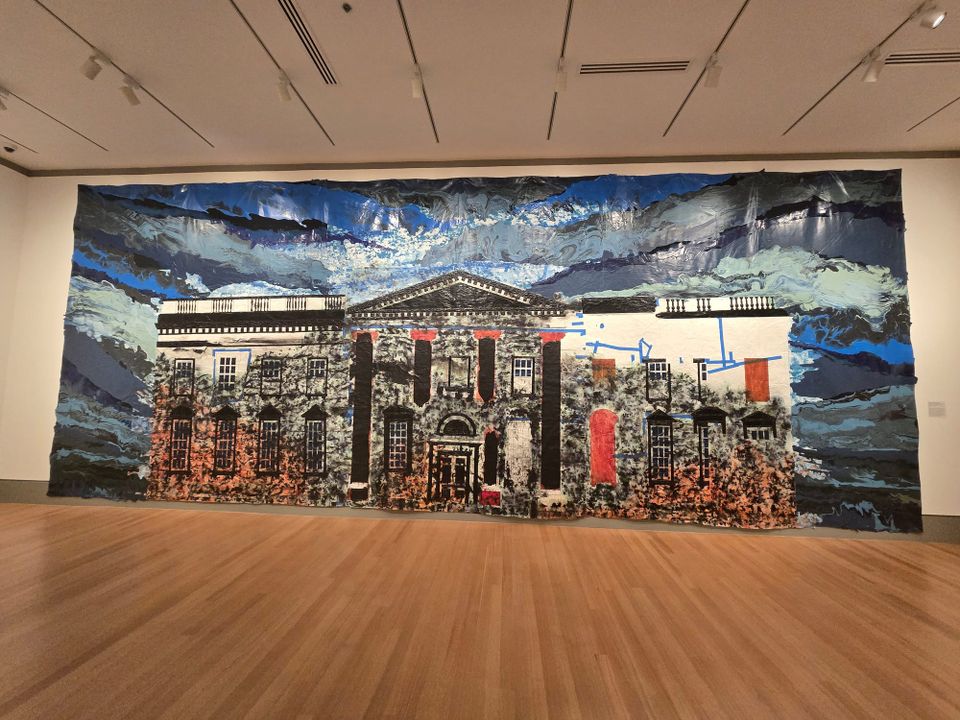
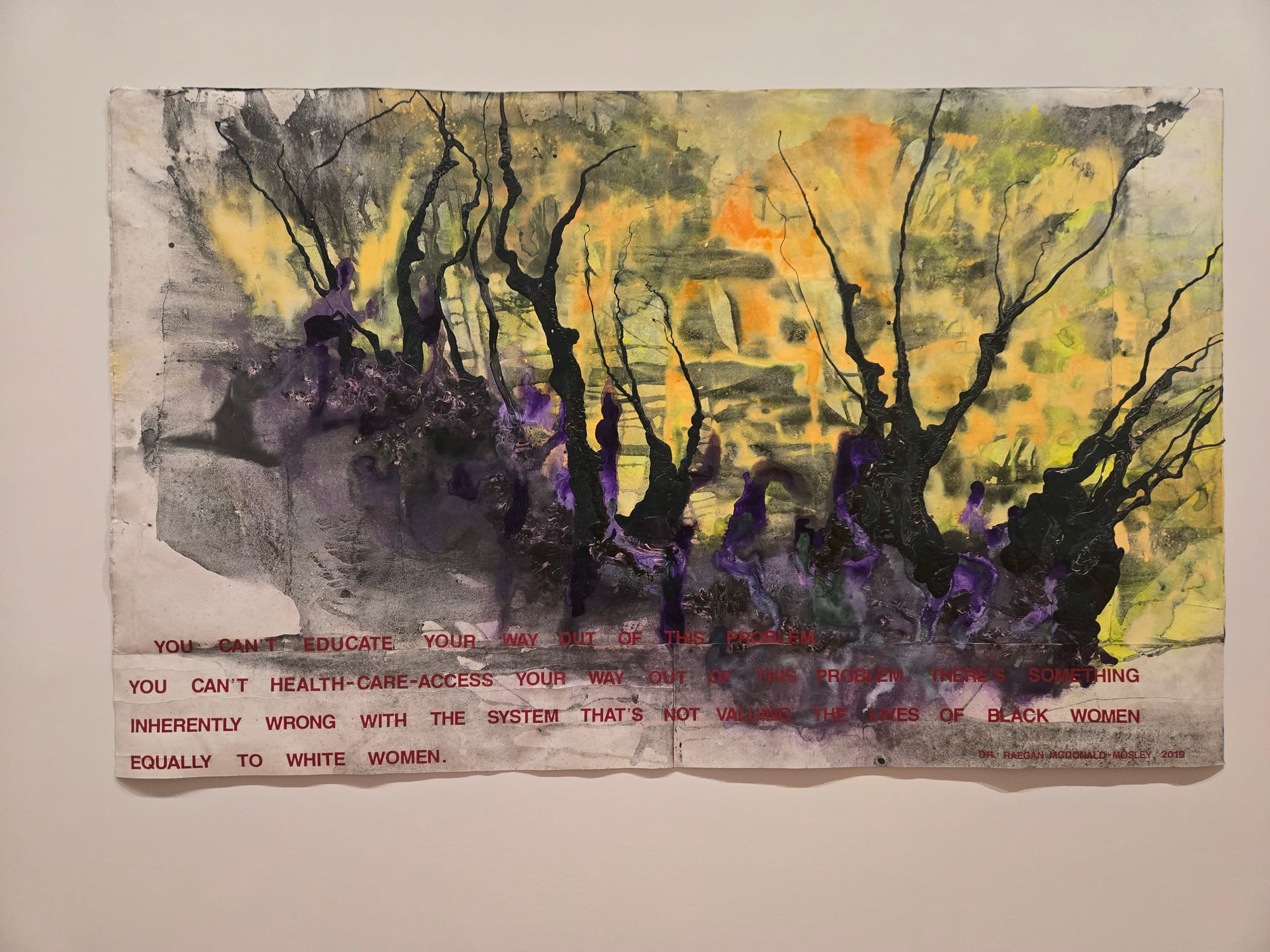
The class was taught by someone I was acquainted with: Jennifer Bartell Boykin, Columbia’s poet laureate. And the focus would be Rodney McMillian: A Son of the Soil, an exhibition that’s been on my must-see list all season. McMillian’s multidisciplinary work, which ranges from abstract paintings on thrifted objects, to sculptures from salvaged materials, and video installations, centers on land, body politics, and concepts of ownership, all topics I’m interested in and write about.
I immediately signed up.
I met Jennifer through some educator poet friends, in what now feels like the way way long ago, a couple of years before the pandemic. We were from different regions of South Carolina, but our writings were both love letters to the places we were from, the kind of places that even other South Carolinians would have a hard time finding on a map. I've always found her work lush and evocative, and one of her poems, “The Creek Knows How to Run,” makes me a little homesick for where I’m from, a place that now, for complex reasons, feels inaccessible for me. I thought this poetry class would give me a chance to learn from her and create something new without the pressure of publication.
The Columbia Museum of Art’s second email was my brain’s first sign that I was in over my head.
Pens are not allowed in the galleries. Pencils only! the class welcome email read.
Right. No ink pens in an art museum. I knew this rule made sense. But I couldn’t tell you the last time I wrote anything with a pencil. “OK,” I thought, and begrudgingly left my navy blue TUL retractable gel pen with a 0.5mm fine needle point tip at home.
As a journalist I’ve gotten used to being physically uncomfortable (mosquitoes, hostile sources) doing my job. When things went off track, I figured them out. I once filed a 5,000-word story from my cell phone using the Wi-Fi siphoned from a McDonald’s in rural Alabama because my laptop was on the fritz. And now here I was grumpy about changing from a pen to a pencil. How had I grown so soft? I immediately started to spiral.
More questions: Could I turn my professor brain off? Would I be able to get my arts criticism voice to stay quiet? What would it mean to decide to be part of a low-stakes creative group, even if just for an afternoon? This should be so simple, I think. Why is this so hard?
This is when I started to fear that I am a hypocrite. As a teacher, it is my job to encourage creativity in others, to push them towards breaking the barriers they have about who they are and what they do.
It is always win or learn, not win or lose, I tell my students. I explain to them that I am grading them on the attempt to grapple with their ideas, with their creative expressions as they learn how to harness their creative impulses and calibrate their literary tastes.
But I rarely practice what I preach. I have a fraught relationship with experimentation and by extension, failure. Every time I sit down at my computer it is because I have an assignment, which means something publishable has to fill the page. The story that I signed the contract for must be told, and that copy has to be filed on time. I bury my fascination with more creative ideas under the pile of work that allows me to eat. It is still intellectually stimulating, but sometimes I wonder what kind of writer I would be if I could just get a little weird with things.
I was raised under the concept of constraints. It’s part of the reason I think so much about Diane Seuss’s poem “The sonnet, like poverty, teaches you what you can do.”
I haven't written a poem of any kind since ninth grade, when teachers told us that we had to start prepping our minds for Honors English, the track that would lead to AP English Literature and AP English Language courses that would make us competitive applicants for the universities we were striving to attend.
Even after I left my public high school for an arts boarding school, the idea of constraints persisted. Before we had fun, before we could experiment, we had to learn the rules, then get good enough at the craft so that you can break the rules, teachers told us. But for some reason, I never allowed myself to break the constraint. I still can’t. The stakes have always felt so, so high.
But if I can’t be rebellious, I can at least read the rebels. I often read poetry because I need to feel awe. Reading contemporary poetry, for me, activates a hard-to-access part of my brain. As a professor and a narrative writer, I’m often reading for information and/or for plot development. But with poetry the resolution often isn't in the narrative, it's internal.
I often start my mornings reading a poem or two. And when I teach, regardless of the setting, every session begins with a poem.
I hope, if I study long enough, I can figure out how to deconstruct what a poet has done, and reverse engineer a mechanism of distillation that might be useful in my own work.
The first book of poetry I ever picked up on my own as a post-college adult was Rita Dove's Sonata Mulattica: A Life in Five Movements and a Short Play. I wanted to know more about the figure shrouded in darkness on its cover. Sonata Mulattica is about the life of George Bridgetower, a 19th-century Afro-European violinist.
I spent my high school and college years studying other people's literature. When I got a little diversity, it was often housed under the banner of magical realism. So standing in the library holding a poet’s patchwork about a Black life that was built on archival documents and an artist’s imagination was alluring, even though it felt a little dangerous.
How seductive. What else could poetry unearth for me? Eventually I would tumble into the orbit of poets like Nikky Finney and Tracy K. Smith. I would find books like M-A-C-N-O-L-I-A: Poems by A. Van Jordan, about MacNolia Cox, the first African American finalist in the National Spelling Bee Competition in 1936. Collections like Voyage of the Sable Venus and Other Poems by Robin Coste Lewis and Room Swept Home by Remica Bingham-Risher kept me company as I crisscrossed the country on assignment. In all of their rendered imaginings, the people, mostly Black women, were vivid, pulsing, and alive.
So yes, I live with poetry. I read it and teach it. But I have not attempted to write it for years. The fact that this class was on ekphrastic poetry, a multi-genre mashup of two of my favorite things: visual art and poetry, was especially alluring. Though it feels like most classes on the topic start with the same poem, "Ode on a Grecian Urn" by John Keats that it seems every student encounters in high school.(As a counterbalance, I introduce my students to “The Starry Night” by Anne Sexton and perhaps my favorite work of ekphrasis, “Dinosaurs in the Hood” by Danez Smith.)
I was relieved when Jennifer started class by asking us to examine Natasha Trethewey’s poem “Kitchen Maid with Supper at Emmaus, or The Mulatta,” titled after the 1619 painting by Diego Velázquez that goes by the same title, from Trethewey’s book Thrall.
After, Jennifer read one of her poems, “Louis Armstrong Plays for His Wife in Giza, 1961,” and encouraged us to think of the visual art in front of us as a launching pad, and not a place we had to stay. It was OK if something we saw in the art triggered a memory, or sent us down a rabbit hole, she said. She emphasized that there was no way to do this wrong. Then she set us out into the museum.
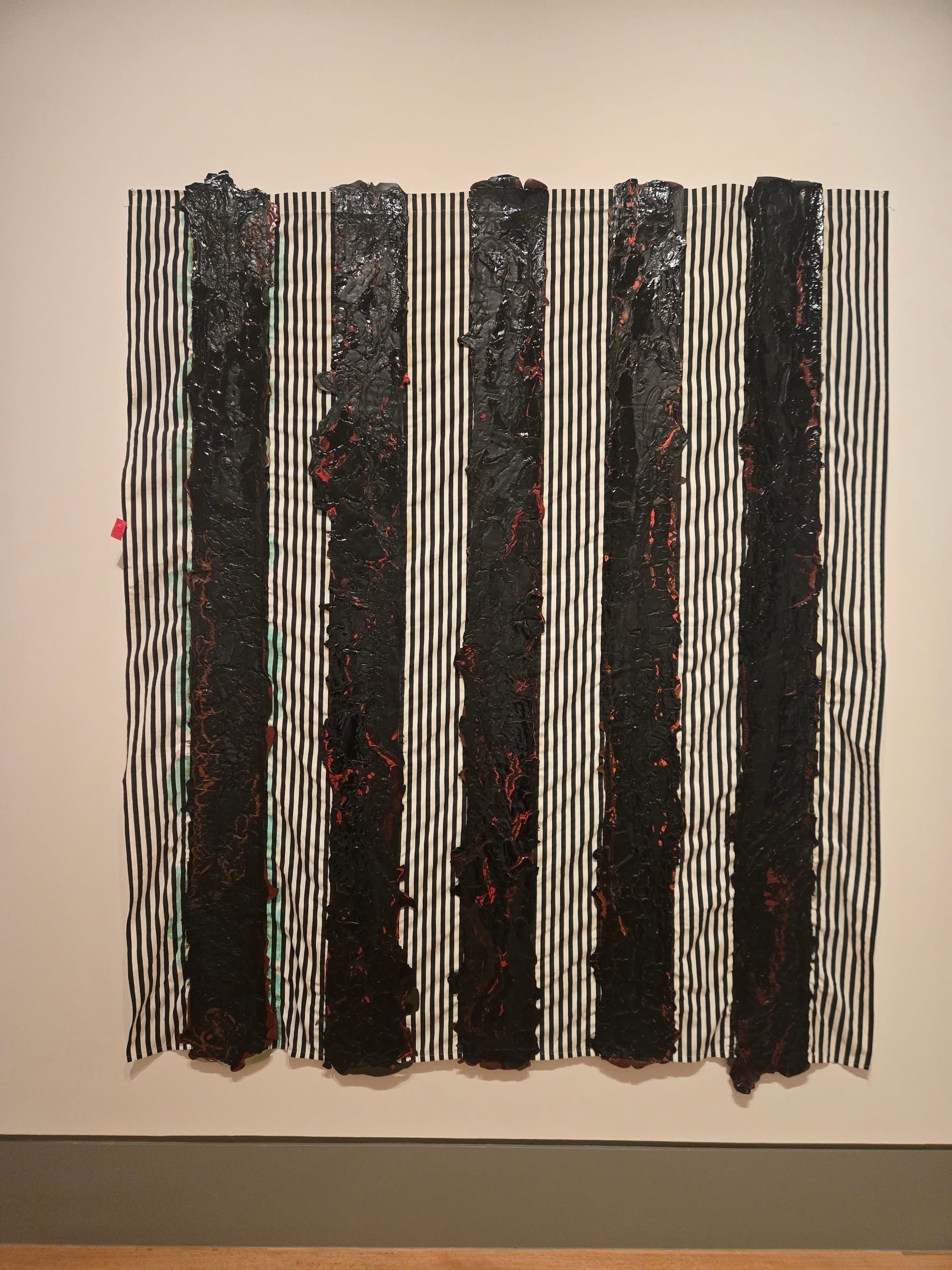
I spent much of my time with two works: “Stripes” and the video installation “Preacher Man,” which exist in rooms next to one another, so the words from the video were audible as I stared at the stripes:
...when the United States be talking about peace, it’s talking about death. They mean that kind of peace. And when the people got a Prince of Peace, the Prince would have to be Death. Of course, this is another kind of mathematics, It’s something that they can see if they’ll just go look in the cemetery.
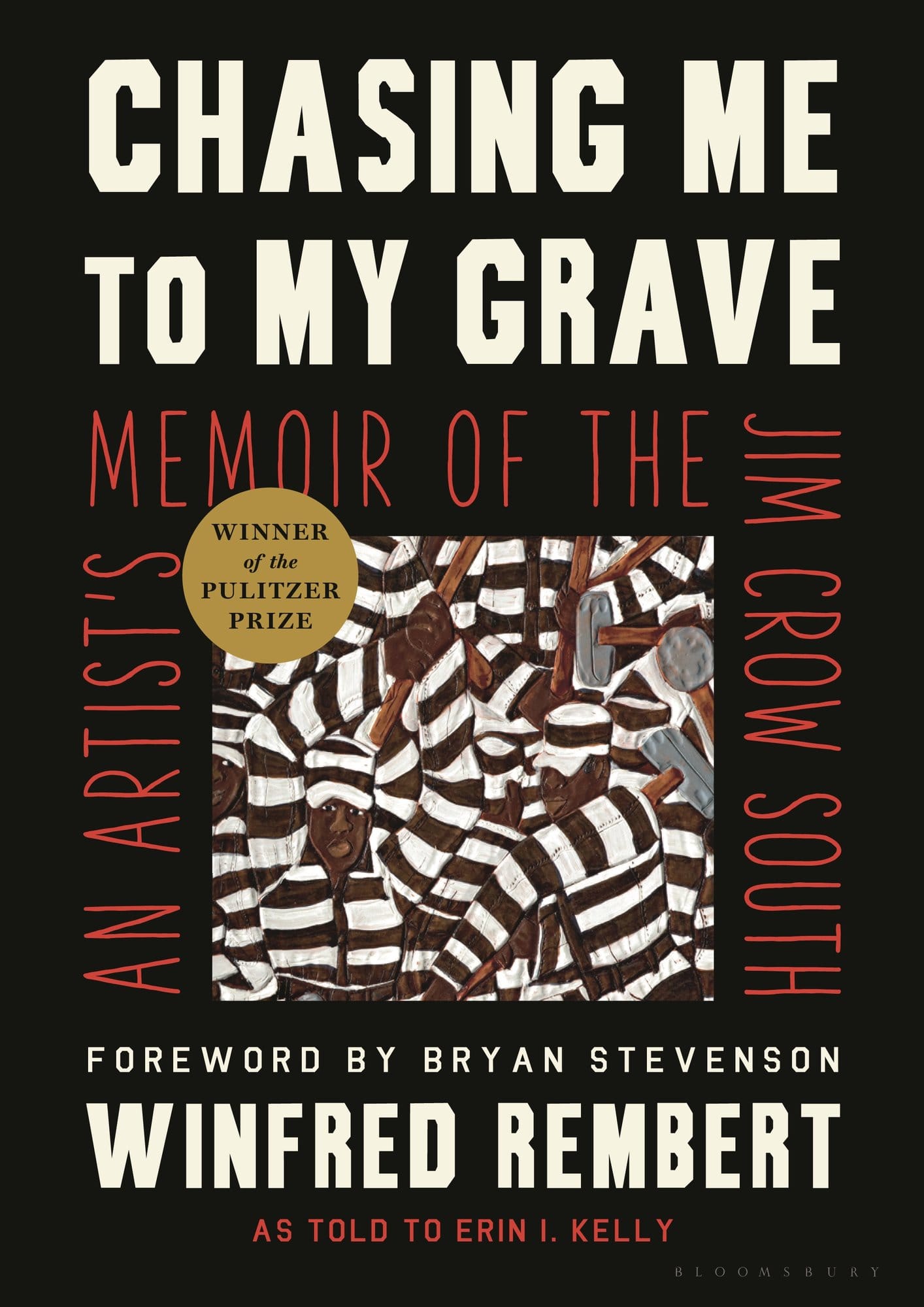
The combination reminded me of a book cover for Winifred Rembert's memoir, Chasing Me to My Grave: An Artist's Memoir of the Jim Crow South. Rembert, who died in 2021, was a leather artist, and a section of one of his paintings that features men working on a chain gang, All Me II (2005), is on the cover. That painting, with its black and white stripes on the men’s clothing, with a little bit of that brown-red russet color peeking out, felt in conversation with the same color McMillian uses in “Stripes, 2016” created on a thrifted bedsheet.
“I've been sharing my story, as an artist, for almost twenty-five years. My pictures are carved and painted on leather, using skills I learned in prison," Rembert explains in the opening pages of his memoir. "Leather takes a beating, and whatever you do with it, it will hold its shape. You can carve it up and it will hold your picture.”
Leather can hold the horror, I wrote on the handout Jennifer gave us. Art can hold the pain.
The twenty minutes we spent looking at art and thirty minutes we spent drafting poems wasn’t enough time for me to get out of my own way. I did not write a poem, but I had a sheet of paper full of writing in front of me. I had so much to say that my writing spilled out of boxes and into the margins. It was the first time in ages that I've written without judgement. That feels like a start.
This essay was edited by Maggie Mertens.

Scratch is a weekly newsletter about how your favorite writers are surviving (or not). We are a four-person collective publishing essays, interviews with other writers, and topical inquiries into the publishing and media industries today. If you like what we’re doing here and want to support us, a paid subscription is the best way to do so.
Become a free subscriber to receive our weekly newsletter.

Member discussion