
The Scratch Interview #4: Kristin Collier on the True Cost of Debt
On owing and being owed.
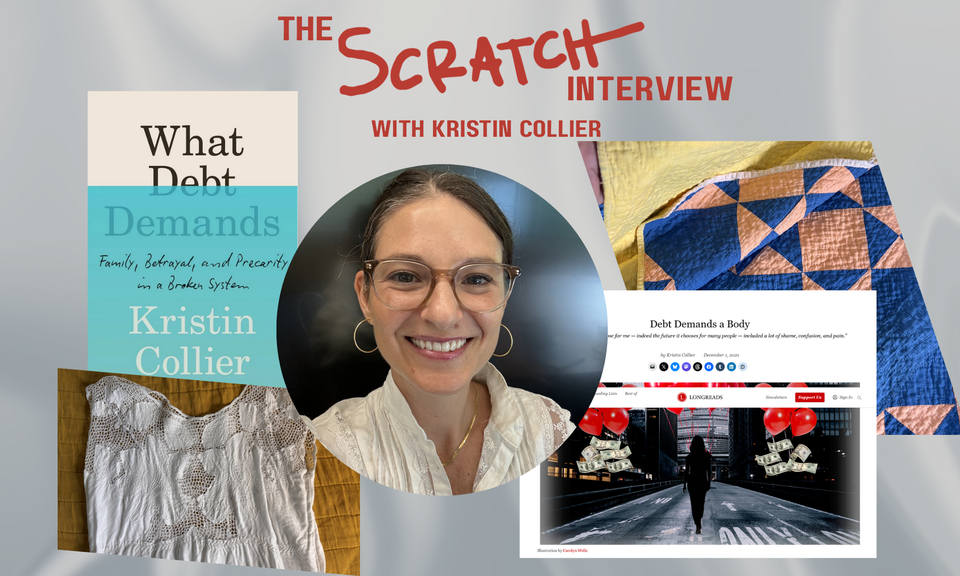
When the author Kristin Collier applied for her first credit card at 21, she was denied. The banker shared the reason with her: Collier already had over $200,000 in private student loans and credit card debt attached to her credit history, though she had no previous knowledge of this.
Her mother’s gambling addiction — combined with banks’ willingness to authorize predatory loans— had created an insurmountable balance that would eventually swell to nearly $400,000.
Because Collier didn't want to send her mother to prison for identity theft, she felt stuck. "Debt decides the future for you," Collier wrote in her 2021 Longreads essay. “The future that debt chose for me — indeed the future it chooses for many people — included a lot of shame, confusion, and pain.”
When I read the essay, it was the first time I’d heard someone articulate the pressure I was under, and the precarity of trying to understand what these six-figure balances that might outlive me meant for my ambitions.
My story is not Collier's story, but we both came from families that didn't discuss money, where at times the emotional costs of living our stories publicly, in small towns, were almost as high as the financial damages.
When I learned that Collier's essay was now a book, What Debt Demands: Family, Betrayal and Precarity in a Broken System, I immediately put it in my Bookshop cart and told the Scratch crew about it.
What Debt Demands is a meticulously researched meditation on the predatory systems that ensnared so many of us before the banking regulations that came about as a result of the 2008 financial crisis. In it, Collier uses the narratives of other debtors to underscore the challenges and frustrations debtors face in attempting to tackle their increasing loan balances.
I recently had the opportunity to talk to Collier about her memoir and her perspective on our country's relationship to debt at a time of extraordinary financial hardship.
This interview has been lightly edited for length and clarity.
Latria Graham: As a fellow teacher, the things that I go into debt for are meant to meet the needs of my students. I’m at a public university, so we often can’t get funding ahead of time, and the modern American education system basically runs on student loans. How do you think about this system now? Because as educators we’re still in it — I know those loans pay for at least part of my salary.
Kristin Collier: At my first two teaching jobs, I was probably teaching a similar population of students like yours [but in high school]. I think one of the things that felt especially complex is that we were really trying to get all the students into college, which I think is great. I think college can sometimes be a path out of poverty for folks, and it gives people lots of autonomy. But for lots of students, it means debt.
We were trying to navigate these decisions with students in such a way that they hopefully wouldn't have to take on debt. Sometimes that was possible and sometimes it wasn't. But I felt like I was kind of selling them on college being a thing that would offer them the life they really wanted, and that just isn't true for lots of folks these days because of student debt, because of poor wages in the workforce, unions being gutted, and fewer opportunities.
I always felt a little bit conflicted with my messaging around it. I just wanted them to feel really hopeful about the future. I think every young person deserves to feel that way, but it's hard to balance that with the reality that might await them.
Then my last school was a private school, and so that was . . . I had a really different population of students. I mean, it was racially pretty diverse but economically not. Most students had parents who'd been to college. Even students who were on a little bit of financial aid were largely paying a lot of money, and I think the cost to attend was $33,000 a year or something.
Whoa.
I know, right? It's so much.
The numbers make my eyes water.
And some of these students have been attending since they were in elementary school, so multiply that by however many years. They were really wonderful students, and I think many of them were attuned to their own class position, but I was like . . . I have debt, none of my parents have been to college, and my mom was in jail. I blended in with my students culturally, but also felt really different from them, and that was something I was navigating a little bit when teaching at the private school.
Enjoying Scratch? The best way to support our work is with a paid subscription!
What is your relationship now to social media? I ask this because we're always thinking about spending and debt, bodies and labor, and the idea that we carry this tech in our pockets that always wants to sell us something. I was talking to a friend yesterday, and because I grew up in a produce stand and often put hundreds of watermelons on a truck every day, I still sometimes calculate things in the price of watermelons. Like, I still think about my labor in that very particular, intense way.
That's another good question. I tend to feel sort of tortured about buying things. I have a comfortable middle-class salary now for the first time in my whole life (even as my husband and I are paying a lot of money for daycare). And we’re probably not saving at the rate that financial planners would recommend, so I have the ability to buy things that I need, usually, without a lot of stress — but I still get stressed about it, you know?
Social media will market something to me that I've been talking about, or searching online, because they have all that data on us that they're constantly repackaging into sales. Then I'll spend so long looking up so many different products, because I want to make sure that I get the absolute perfect thing. And of course, there often isn't a perfect thing, because these are just items of consumption, and any of them will do.
So I think one of the ways that I combat that, for better or worse, is I like to buy a lot of stuff at estate sales, or in used places, and these feel like really good deals to me.
I mean, that’s fair. I've spent three weeks looking for the perfect toaster oven. Like, it has to be the toaster-iest toaster oven at the best price, and I make myself track it for weeks to be sure this is the best I can do. That I’ve put in the effort.
I don't want to feel guilty for buying things I need, or occasionally just things I want. I think an ideal world, where all of our needs are met, we just get to buy things that we want sometimes. But I also want to distinguish between that and trying to self-soothe through purchases, and being like, fuck it, I should do whatever I feel like because I deserve it. I'm trying to balance those two ends of the spectrum, and I don't always land in the perfect place.
This idea of living with a public story like yours, of being very candid and writing this book . . . how did you negotiate the judgment of people? How did you recount it without it destroying you?
It was hard. On the one hand, it felt really important to me that people understood my mom with the complexity that I understand her. I was really worried about her becoming a villain in the book. I wanted her to be able to read it, even though I knew it was going to be tough for her, and I think it was.
Oh, she’s read it!
Yep. I was like, you don't need to read it, but she wanted to. I know she was proud of me and also felt really exposed, because she was exposed. I feel like it's important to say I didn't ask her permission to write it. I made the decision that I was going to [write the book] and that I needed to for myself. And then the other thing I felt, as I was writing the book, was that there were places I felt embarrassed knowing I'd been kind of out of touch with people who knew me at different points in my life, and would get this massive update of what had happened in the years since they saw me. I was worried about them being left with a sense that I was messy, and poor, and kind of a shit show.
Joining The Debt Collective was a really important thing for me. It’s a union of debtors who are working to combat unjust debts, basically, and to create universal systems to care for each other. Getting to be with all these other people who had debt, where we were openly talking about debt all the time, really helped me to understand that most of the country has a lot of debt.
There is a small subset of folks who only have good debt, like mortgages, and nothing else. And I knew a lot of those folks, because I went to an expensive school where people had many generations of money, or at least had parents that had pretty good jobs at the time, and so they didn't have to take on debt. Learning that there were other stories made me feel kind of less alone.
There’s something about the illusion of money that I’m sitting with. Every time I hop on Instagram or Facebook, I get these “come with me into Hermes” reels or “come in with me into Chanel” videos that lead me to believe that people seem to be chasing . . . I think it's a misnomer to call it luxury.
One thing that comes to mind is that I think so much of life in the U.S. right now is so deeply toxic and unstable. People are often being told by the political system that they're okay. Not necessarily in this exact moment, with the war in Iran and a million other horrible things happening globally, but I think in a general way. People are being told things aren't that bad. And yet people aren't able to care for themselves. They can't afford to go to the doctor, or to get a house, or to pay rent, or to have kids. So much of contemporary life here is so uncertain.
I think there’s something about these items of consumption, especially ones that look really beautiful or are being delivered to you by people who seem to be rich, that I think give you a sense of power and control that's not really possible in your life.
I can totally see why the belief that a wonderful pair of really cozy sweatpants are worth whatever the price tag is in order to, like, feel good in your body when so much feels bad.
There's a little bit about gambling and addiction in your book, but since it published in early 2026 it was probably finished in early 2025, and DraftKings and other gambling entities have grown since then. People are betting on whether or not we're going to commit a genocide in other countries. You can bet on anything right now, which is its own thing. So I’m thinking about these addictive structures and what they’re attempting to pull all of us towards.
I'm just beginning to track some of these new gambling markets like Polymarket, which is the one you mentioned earlier, where you can bet on whether we're gonna commit genocide in Iran — which is absolutely horrifying. It makes me so sick to think about people betting on these sorts of things.
I was wondering if you've ever been in a casino and how you think about those spaces and the way they’re designed.
I have been to a casino, I think, twice maybe? I went to a slot machine in Vegas during a layover a long time ago, and it made me feel sort of sick. I might have even been in college. I don't know that I was aware of what had happened with my mom yet, but it just felt really bad to me. I worked 30 hours a week all through college, and it was really hard for me to afford my rent and the other things I needed, so throwing away money felt awful, and I didn't want to do it for that reason.
When we think about things like credit scores, predatory lending, even social media . . . so much of this is American-made, right? Thinking about family and generations and debt. When my dad died there were heirs property issues, and as I was trying to work my way through that system, I learned that much of it is uniquely American, or at least starts with an American focus on money, power, bodies, and that obsession ripples out to other places across the world. It seems like this is our major export.
What an interesting thesis about debt being one of America's major exports. I didn't do as much contemporary research on what debt looked like in a global context, although I have read David Graber's work and have a sense of how financial institutions like the IMF (International Monetary Fund) and World Bank work to indebt countries in the Global South, forcing these structural adjustments on countries that make it basically impossible for them to live.
One thing that came to mind when you were speaking is the way that debt is almost always shared by families. It's sort of unavoidable, even when it's housed within one person's name or identity, and I think there's lots of reasons for that. One of them is because we have a poor social safety net in the U.S., and our social provisions are so bad. We are forced to rely on families in ways that we shouldn't.
I'm teaching a class in a correctional facility in Minnesota right now, and we were talking about debt in class. Recently I shared a little bit about my story, and many of my students had family members [who’d] take out utility bills in their names. They didn't realize it until they were older.
People are starting to wake up to the fact that morality and money shouldn't be coupled, but that punch is strong. What is your interior voice like now?
I've had to negotiate my personal voice to talk back to myself quite a bit about this. One of the things I'm thinking about in the book is what it means to be a good debtor versus a bad debtor. To some degree, I think the state is defining what it means to be a good debtor, and then that's rippling out into all these cultural institutions, too.
I keep thinking about community power and local action, particularly because you’re in Minneapolis: Those of us who paid attention to ICE’s occupation of the city saw what happened when community members worked together and didn’t back down. I read the Los Angeles Review of Books (LARB) piece you wrote about that time, about people who sheltered in place, and I appreciated that there was a translator. Pay rates are so slim, and people often rely on apps or technology instead.
Yes, but you miss the nuance [that way]. You miss the laughter. You miss the positive idioms. You miss some of the humanity of a conversation.
Can you talk more about the value of a translator and if you spent money on them? Some of the folks reading Scratch are editors, and I want them to understand why those line items are really important fucking line items.
I paid two different translators. One had the certificate in interpreting, and is a neighbor of mine who was born in Puerto Rico, and so he's a native speaker. I paid him for one of the interviews at like $30/hour? We rode together to the interview, so I also paid him for the ride there and back. That was a pretty big chunk of my payment. I think LARB paid me $350 for the essay, and I spent a lot of hours reporting it, but my goal wasn't to make money.
The other interpreter was another native speaker, and she didn't want money; she wanted me to donate it, so I gave it to one of the community rent funds. Then there was a little bit left over that I gave to someone else to give to one of the families.
I was sort of like, I don't know if, ethically, I can just give you this money as a journalist, but I'm gonna give it to some of your friends, who I think will help you pay for rent with it.
Were there things like that that you did for the book? Are there things people should know they should be prioritizing?
I feel like I didn't even try to negotiate anything with the book. I was so stunned to even sell a it.
It felt like such a miracle that it felt hard to ask for anything else, or to know what to ask for in terms of how [the publisher] might have supported some of the research process. I did pay a lot of money for fact-checking, or what felt like a lot of money to me. I can't remember the exact number now, because it was many years ago, but I think it was $5,000? I know that's a thing that a lot of outlets don't pay for anymore, or that presses don't pay for — it's just on authors, in most cases, to pay for it.
I know we have to wrap up in a minute, but I'm thinking still about Allison, one of the subjects from your book. She got pushed out of school, but she articulates that she wants to go back to school. She says I miss learning. What do we do? How do people continue learning outside of a framework that requires tuition. What does that desire to learn look like for you right now?
The word that kept coming to mind when you were speaking was this idea of study, which Fred Moten and Stefano Harney talk about in Debt and Study — they emphasize that study can exist outside the university. I think it looks like people gathering for intellectual work, and art, and co-creating something together. I sometimes feel a lot of pressure to go to a lot of literary events, because I really want to support everyone, but also I have such a wonderful time when I'm there, and I feel like this is learning. I'm getting to hear this beautiful work and hear people talk about their work.
The Debt Collective has this whole political education program called Jubilee School, where they have organizers, and scholars, and folks coming in, and you can join and get a remarkable education for free. I have a friend who teaches at the Brooklyn Institute for Social Research, and there are all these awesome classes being offered; they do have a cost associated, but I think there's a sliding scale. You get together with other people outside of the context of a university to read theoretical texts. I haven't had a chance to participate in those, but I want to. I want to continue to seek out things that feel challenging for me.
When I feel that pull, I'm reminded, oh, there's all these other ways I get to be with people where I can learn from them, and I just want to find and create more of those.
This interview was edited by Rahawa Haile.


Scratch is a weekly newsletter about how your favorite writers are surviving (or not). We are a four-person collective publishing essays, interviews with other writers, and topical inquiries into the publishing and media industries today. If you like what we’re doing here and want to support us, a paid subscription is the best way to do so.
Become a free subscriber to receive our weekly newsletter.

Member discussion