Strange Currencies: On the Costs of Self-Publishing
"If my book was going to exist, it was — it had always been — entirely up to me."
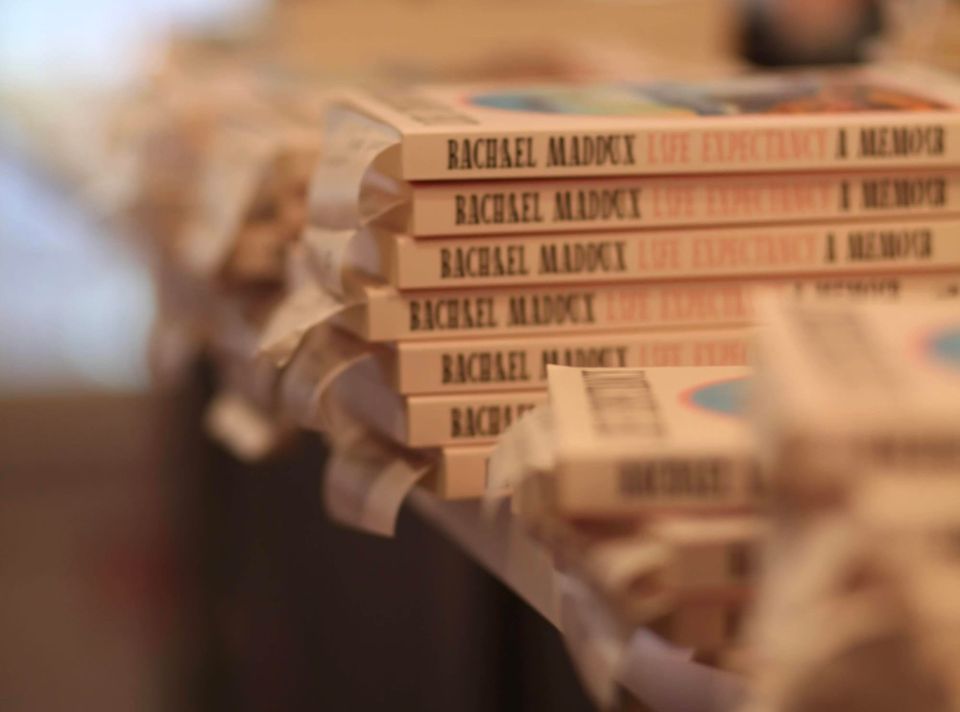
In this week's newsletter, we're featuring a guest post written by Rachael Maddux, an essayist and critic featured in Scratch's 2017 anthology, about why she self-published her memoir, and what it cost her.
One housekeeping note: Summer is officially here (hallelujah). Our group is taking a brief one-week break to recharge. Scratch will return to your inbox on July 8th. But first, here's Rachael!
–Manjula, Latria, Rahawa, & Maggie
One way to tell the story is in facts and figures: I wrote a book and it did not sell. I wanted it to exist so I published it myself. It’s called Life Expectancy: A Memoir and it came out on March 24, 2026. So far, I’ve spent about $3,600 to publish and promote it. I’ve sold just over 250 copies. I’ve grossed about $1,300. I have spreadsheets to prove it! But that seems insufficient, doesn’t it, this logic of columns and cells? Anyone who has written a book — unpublished or published, and by whatever means — knows that there are too many nebulous transactions to reconcile, too many obscure deductions and windfalls, to claim a rock-solid bottom line. I would say I’ve had to become an existential accountant to make sense of it all, but I was one already: a memoirist obsessed with mortality. That’s how I got into this mess.
Another way to tell the story is as a matter of time and pride.
In 2012, I was twenty-eight years old and dead-set on publishing a book before I turned thirty. In 2013, I was writing what I knew would become that book, though I wasn’t sure yet what it was about. In 2014, I began to know — it was a memoir about my childhood preoccupations with death — and then I turned thirty, bookless and (I thought) humbled (ha ha). In 2015, I finished the first draft. In 2016, I finished the second draft on November 8, my thirty-second birthday, then kicked back with a whiskey drink to watch the election returns (ha ha ha). In 2017, I finished draft three, queried agents, signed with my agent. In 2018, buoyed by rounds of notes from her and my writing groups, I wrote drafts four, five, and six. In 2019, I wrote draft seven; it was a book about death, which meant it was also a book about life, but life wouldn’t stop happening long enough for me to pin it down. In 2020, I wrote drafts eight and nine — still unsure how to end it, then finally sure, or so I thought.
Enjoying Scratch? The best way to support our work is with a paid subscription!
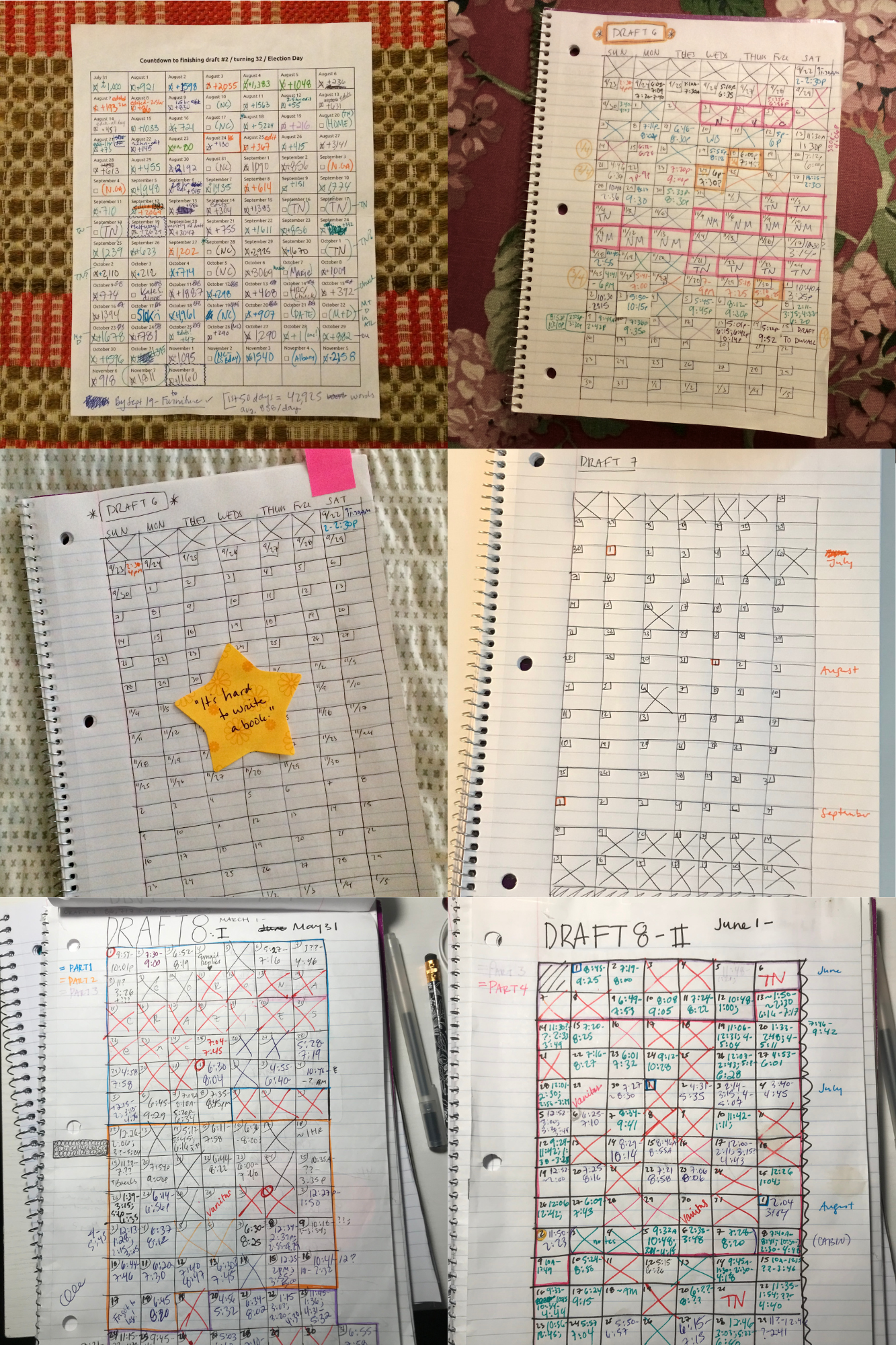
I worked a day job in those years — first as an editor at a university alumni magazine, and then as a writer in various capacities at a tech company — and my husband and I weren’t yet parents, and so I mostly wrote in the evenings after work and on the weekends. When I was locked in on a draft I would track my writing sessions down to the minute, logging my start and stop times in the small boxes of a calendar drawn or pasted into my notebook. Days I didn’t write I’d mark out with an X, or a shorthand excuse — the location of a trip, the name of a restaurant I visited instead of my desk. It was as if I might need to add it all up one day and present somebody with proof of my diligence. As if the book itself, all the versions of itself, wouldn’t be enough.
Enough for what? I’m not sure now that I could’ve told you. Maybe if I’d been forced to articulate some sort of answer, bring it fully outside my mind, I wouldn’t have clung so tightly to it — this confounding notion that writing was my destiny, my soul’s true calling, but that also it was something I had to earn, had to be continually granted by decree of some governing body. First it had been my teachers, then college professors, then magazine editors, and now I had advanced to the final round: the publishing industry. I thought of the editor who would acquire my book as the Blue Fairy who’d turn me from a pile of splinters and paint into a Real Author. And the stamp of an imprint’s colophon on my spine — waddling bird, leaping hound, watery swoop of my own first initial — would make me not just real but sanctified.
In the spring of 2021, my agent sent the book out on submission. I was not a fool; or maybe I was. In my years of snooping on the publishing industry from the sidelines I’d internalized enough stories of shocking success and miserable failure to set my own expectations simultaneously way too high and way too low.
I alternated between daydreaming of the manic ping ping ping of editors’ excited replies cascading into her inbox and bracing myself for rejection, for a slower trickle of painful but well-reasoned no’s. Instead what happened was: nothing. Or, almost nothing; after years of dramatically deploying the phrase “TOTAL CRICKETS!” in my retelling of the saga, I recently came across an email from my agent in which she reported “a few light passes” in the earliest weeks, but they were light indeed, light enough to be drowned out by the months of silence that followed. But it was summer, after all, and this one, with its heady post-vaccine optimism giving way to the recursive dread of the Delta variant, seemed especially sluggish. My agent prescribed patience. I attempted to comply.
It helped that, in early 2022, I got pregnant and proceeded to spend the next nine months and most of the following year zooted on various combinations of hormones and sleep deprivation — not patient, exactly, but distracted, uncharacteristically docile. But in the fall of 2023, just before the baby’s first birthday, she decided that breastfeeding was a stupid waste of time and in my subsequent biochemical crash-out the book and its unresolved fate seemed suddenly, acutely intolerable to me. I emailed my agent in a long-delayed tizzy and for some reason proposed that we give the submission another six months. By the time we talked again, halfway through 2024, my family had executed a full relocation from Atlanta back to Chattanooga, Tennessee, where we grew up. My daughter, now a walking, talking toddler, had already forgotten her old life. I mostly had, too. When I told my agent that I was ready to pull the book from submission, I imagined it would require some absurd physical effort: raising or lowering some type of flag, flipping a comically oversized breaker switch. Probably she just sent a few emails. Even more probably, there was nothing to it at all — just a vague prayer muttered over the memory of a sailor long ago lost at sea.
I knew, from following the publishing travails of friends and strangers, that this kind of thing happened, that it was called “dying on submission,” that the generally recommended response was to stick the manuscript into a literal or figurative drawer, perhaps to be resurrected years later, more likely to languish indefinitely. But my book about death did not feel dead. It did not feel like something that could be safely stuffed away. It had been in my head for one-third of my life; I had written and rewritten it nine times over; I’d thought about it every which way. I’d thought plenty of bad, wrong things about it — like, If no editors want to buy this book then maybe it doesn’t deserve to exist and perhaps by extension neither do I? — but mostly I thought, This is a good book. My agent thought it was a good book. The friends and fellow writers I’d shared it with, the most thoughtful readers I knew, thought it was a good book. Why wasn’t that enough? Why shouldn’t it be?
In the depths of submission-limbo despair, I thought often of a book I’d once encountered, the childhood recollections of a friend’s mom’s old friend. He’d published it himself, was selling it on Amazon and in some coffee shops around their town. The copy I saw on my friend’s mom’s coffee table had cover stock so glossy it looked wet; the low-resolution cover image was pixelated into oblivion. Inside, the pages were oddly thick and bright white, the text double-spaced like a college term paper. It filled me with rage. Who did this guy think he was? Why did his book get to exist in the world and mine did not? But by the time my book was officially off submission, when it was time for me to shove it and perhaps myself into the proverbial drawer, my feelings had softened. The rage had been jealousy all along, and now my rhetorical demands were earnest questions: Why did his book get to exist in the world, who did he think he was? Maybe it was pride or delusion or vanity that drove him to self-publish, but then again, I’d been out here pinning all my hopes and dreams to the whims of an industry that could hardly trusted to function in its own self-interest, and now I was on the verge of scrapping it all just because at a particular point in time it didn’t strike one of a few dozen editors as something they could convince their bosses would make their bosses some amount of money.
I had always been certain that this book would exist, even before I knew exactly what the book was, even before I spent one-third of my life making it real, but I always believed its ultimate form required the approval of some all-seeing, all-knowing, Manhattan-based entity. Now I understood: If my book was going to exist, it was — it had always been — entirely up to me.
Another way to tell it: as a love story. Because, yes, the book was up to me, but here I must disclose the most significant source of sustenance, literal and otherwise, which flowed to me without thought of amortization or return on investment for all of these years, and before, and beyond. How many dinners did my husband grocery shop for, prepare, and hand to me warm in a bowl he’d later retrieve and load into the dishwasher with all the rest while I hunched over my computer? How many hours did he spend talking with me, or being talked at by me, about memory and structure and point-of-view? How many despairing spirals did he haul me out of, how many ego-wounds did he dress and bandage, how many black silent moods did he endure?
And that was all before we had our daughter, before the day halfway through my parental leave when I told him that I was dreading my return to work at the tech company — just couldn’t imagine it, not only because the baby didn’t have a daycare spot despite being on five waitlists since before she was born, although that sure didn’t make it seem any less impossible — and he said, “Well, what if you quit?” I’d considered it, but in the same way I’d also considered getting a facial tattoo or hijacking a plane; it was something people did, of course, but those people were not me. But he’d been thinking about it, he figured it would be a little tight but we could make it work on just his salary and our savings, and then I would be free to hang out with the baby and work on my writing. I acted like this was a nutty idea that I needed some time to consider but I did not, I knew right away that he was right, that it could happen, that it would.
So I had the time, when I needed it, to spend the hours I needed to spend researching how to self-publish, platforms and acronyms, best practices and pitfalls; testing the process with two little books first; revising the memoir for the tenth time; working through snarls with the world’s keenest copyeditor; shoring up the graphic design skills I’d honed as a fourteen-year-old with a Tripod website and a Photoshop CD-ROM; briefly considering paying many thousands of dollars for an independent publicist then just subscribing to a lot of Substacks; sending out advanced reader copies, perhaps too many, to any vaguely interested party; developing a more intimate knowledge of the likes and dislikes of the Instagram algorithm than I ever cared to possess; scheming about the launch party at my neighborhood bookstore — here we are with another imprecise tally, and this one goes on and on. How many times have I thanked him? Not enough, never enough.
If you say in the first section of an essay that there are spreadsheets, in the fourth section of the essay they absolutely must go off. So here they are — kapow.
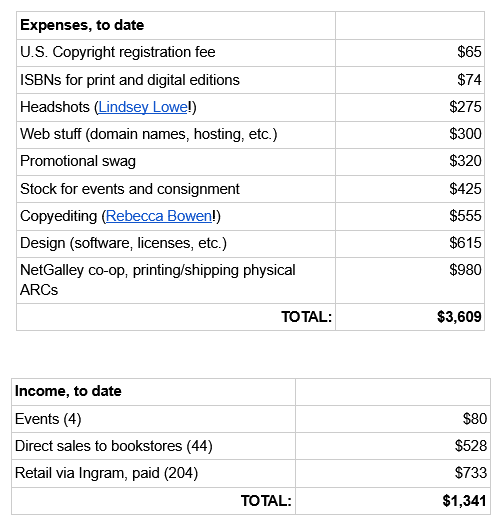
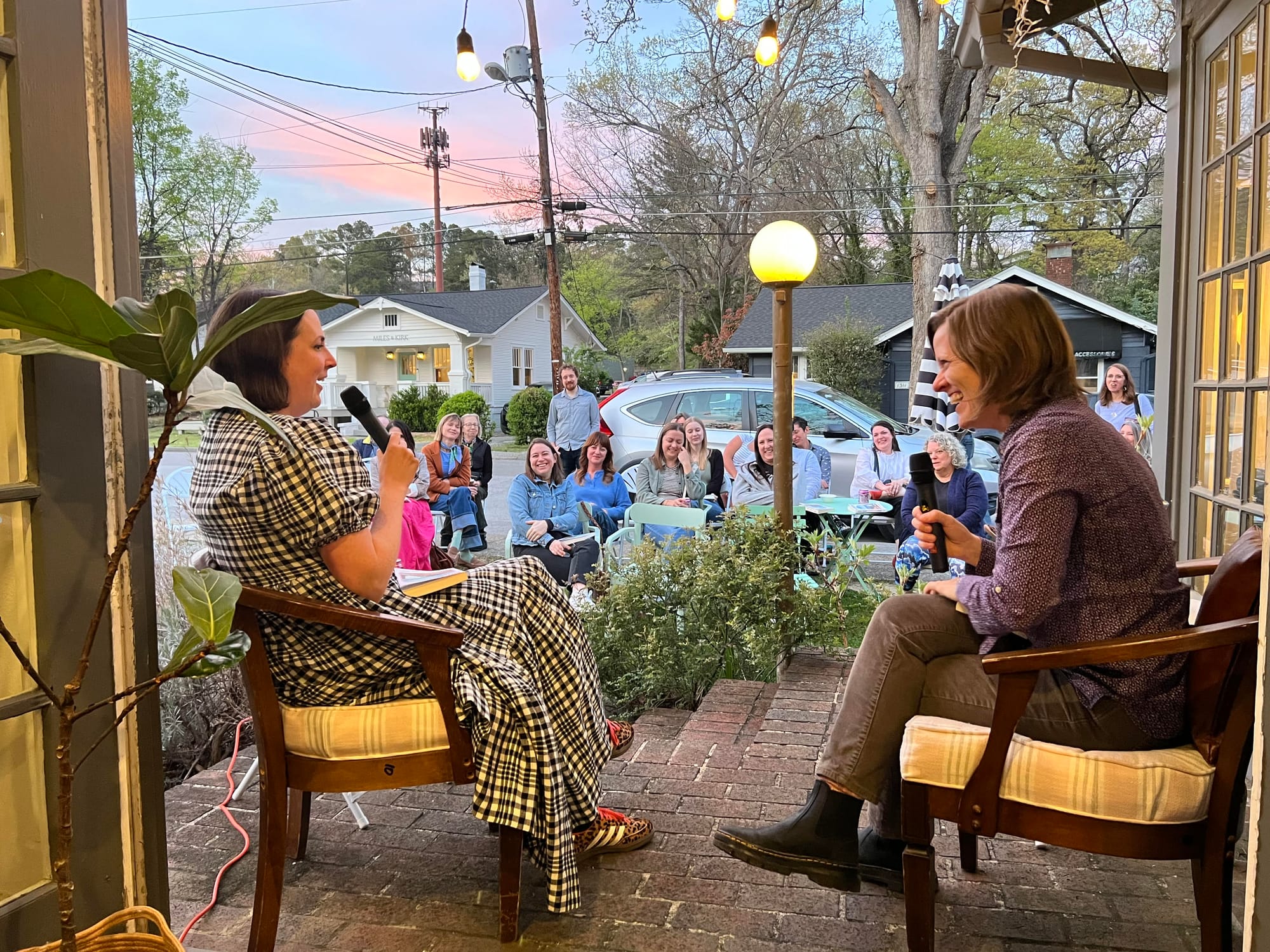
They are simplified from the actual mess of my Google Sheets, but even those have gaps, I know. There is no line-item for the feeling of holding the first proof in my hands, for instance, or my husband saying, “Look, Mama wrote a book!” or my daughter pointing to my face on the back cover. Or for the sunset at the launch party at my neighborhood bookstore where my family and old friends and new friends and strangers gathered and laughed and cried under a March sky the exact pinks and blues of the cover. Or the readers saying yes, me too, I felt that too and this was not me but I see you. Nowhere to log the photos snapped of the book in bed, at the beach, a restaurant in Paris, a plane to Japan, or my knowledge that the story is outside me now, where I always knew it should be, where it will always be now, even after I’m gone. One day I hope these spreadsheets show that I’ve broken even. But by all other accounts, all conceivable metrics, I’m so far in the black, I’m golden.
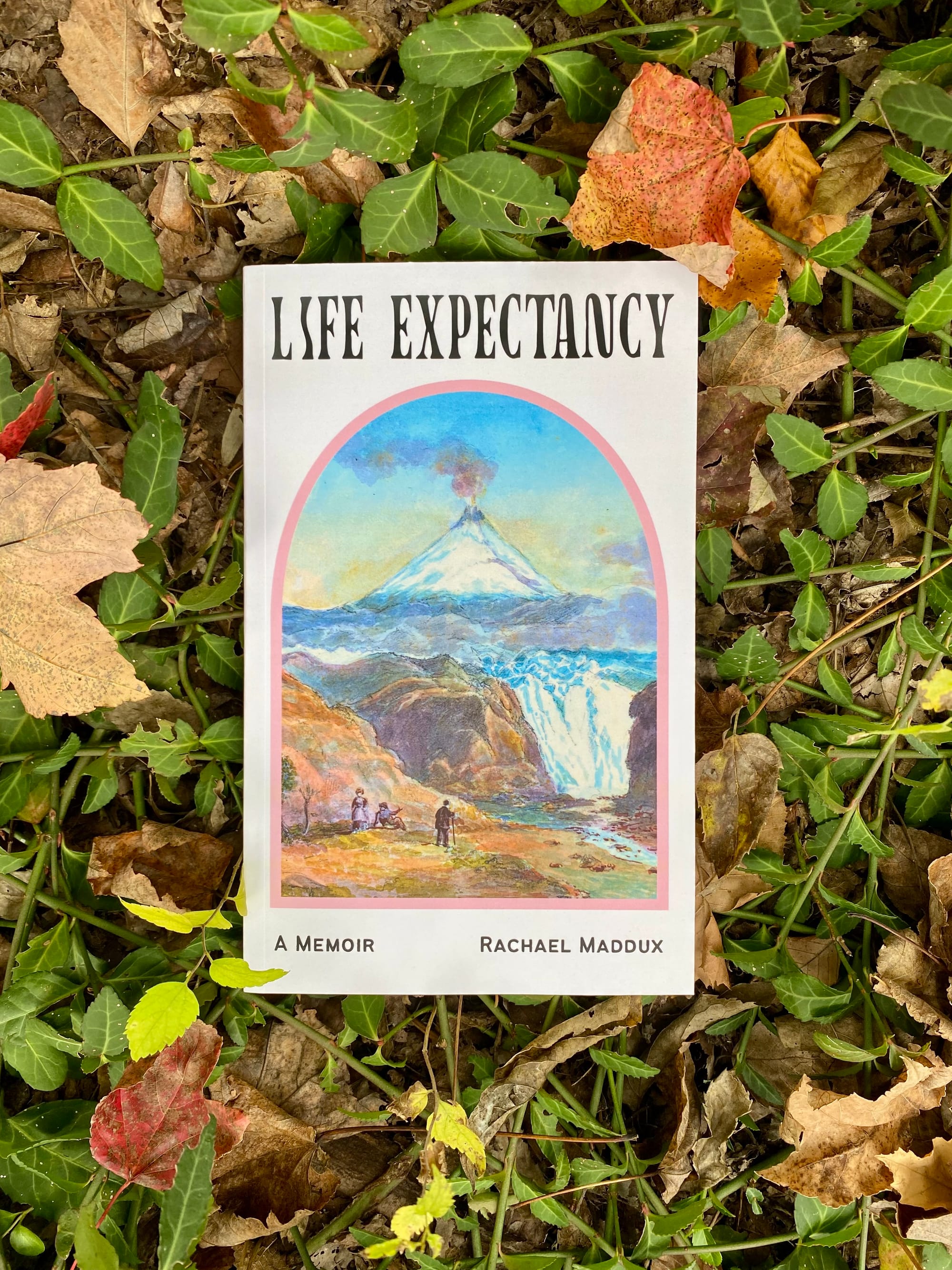
Rachael Maddux is the author of a memoir, Life Expectancy, and two short essay collections, The Void and Third Person. Her work has appeared in the Oxford American, Virginia Quarterly Review, Garden & Gun, and elsewhere. She lives in Chattanooga, Tennessee, with her family. Find her online at rachaelmaddux.com and instagram.com/rachaelmaddux, and subscribe to her newsletter at vanitas.me.
This essay was edited by Latria Graham.
Scratch is a weekly newsletter about how your favorite writers are surviving (or not). We are a four-person collective publishing essays, interviews with other writers, and topical inquiries into the publishing and media industries today. If you like what we’re doing here and want to support us, a paid subscription is the best way to do so.
Become a free subscriber to receive our weekly newsletter.


Member discussion