List Full of Daggers
What we stand to lose when paperback nonfiction disappears.

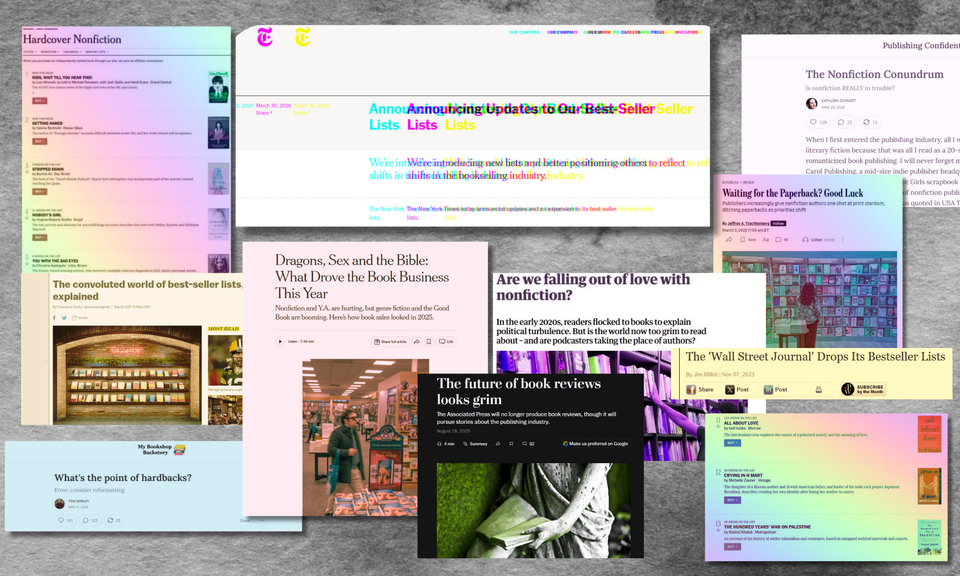
On April 7, 2026, the cost of ordering two recently published nonfiction hardcover books through Bookshop.org was higher than the cost of an annual subscription to any of the culture-based, worker-owned co-ops that have emerged in the last five years, including Scratch.
This realization shook me as a writer of nonfiction (one with friends who seemingly publish nonfiction books every other week). For the sake of my sanity, I try hard not to live in a world of binaries, of booms or busts, of celebrity book club anointment or the threat of a poor track record that makes it incredibly difficult for authors to sell their next project. But in all my talks with writers in recent years, one feeling is clear: things are bad.
Two weeks earlier, the New York Times published an update regarding their bestseller lists. Among the announcements was one that the paperback nonfiction list would be moving from weekly to monthly, to “better align with current market trends.” As such, the paperback nonfiction list would no longer appear on the main best sellers page, and would instead spend 75–80% of its life buried within the void of the Monthly Lists dropdown menu from week to week.
For those who aren’t writers, I’m certain this sounds like a niche development that primarily affects neurotic nonfiction authors, but this move by the Times is only one in a long list of blows to those of us who 1) aren’t famous or politicians, and 2) genuinely research and write about the world and its people.
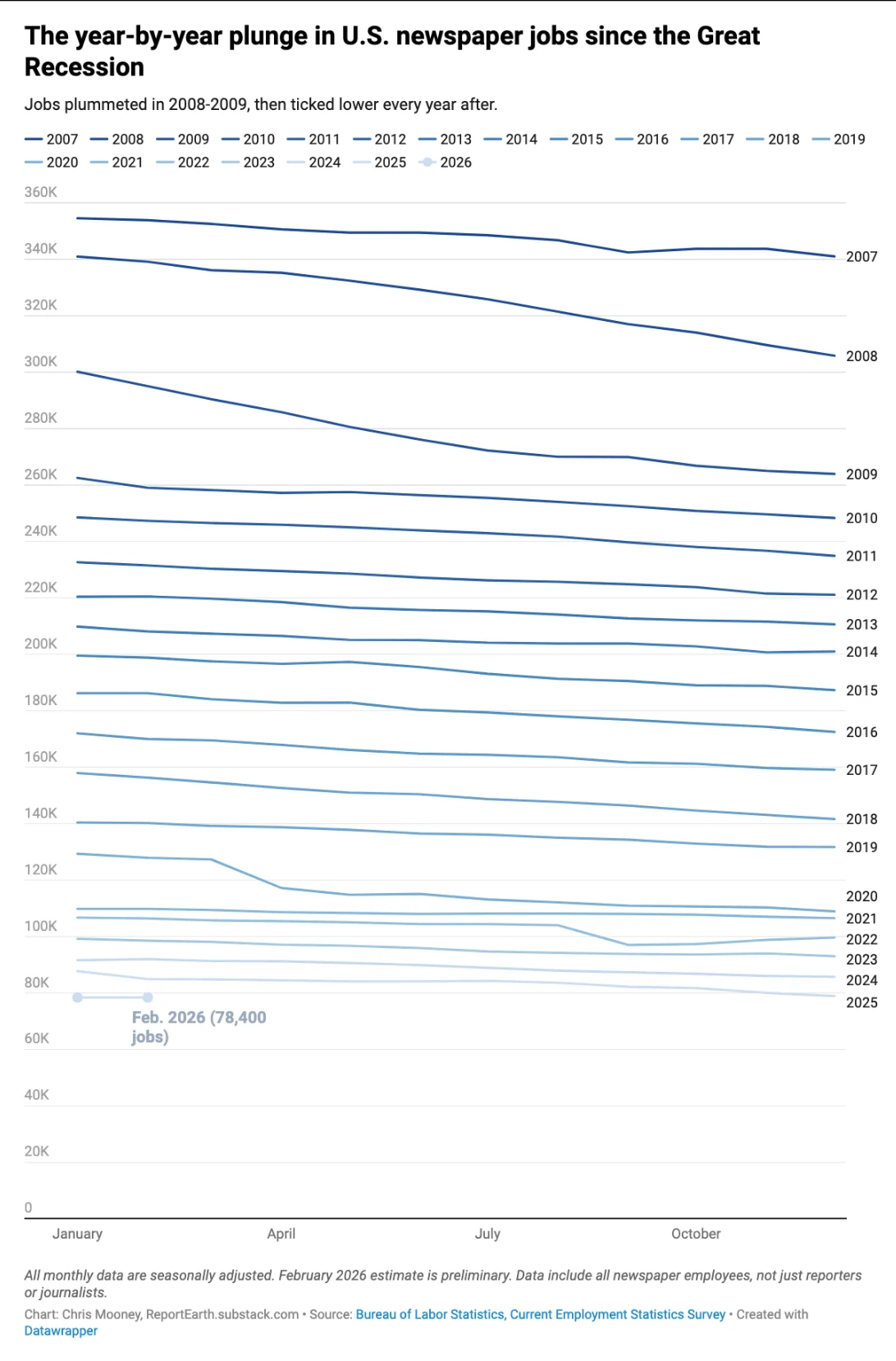
But first, we can’t talk about paperbacks without talking about the fact that everyone is out of work. Those reporters you loved? That magazine no longer on newsstands? The professors who can no longer nail down enough adjunct classes (a long-standing issue), or the ones who were too vocal in their support of Gazans, or the ones whose recorded lectures are being turned into AI slop? Those speaking gigs that dried up? The local papers devoured by hedge funds?
Do you want to know why there’s suddenly a large influx of writers and publishing-adjacent folks offering independent classes on how to write/get published/find an agent/promote your work/tap into your true self/tap out of despair? While it’s true such offerings existed beforehand, it was never like this. Not in such quantity, by authors of such caliber, who five years ago would have been content to carry on in their work as writers. It’s because, so, so, so many of these people cannot find stable work. Scratch exists as a publication because of how dire the situation has become.
Enjoying Scratch? The best way to support our work is with a paid subscription!
What a writer of nonfiction can do, however, is sell a book. It isn’t easy, especially now, and there are few who can live off of their advance alone while writing those 80,000–120,000 words, but once that book proposal is sold, it’s more or less you and the blank page for a number of years.
But there’s a problem — nonfiction book sales are in the toilet. In December 2025, Emma Loffhagen wrote for the Guardian that in the UK, “the category is down 8.4% between last summer and the same period this year – nearly double the decline in paperback fiction – and down 4.7% in value.” Some of the listed culprits are a desire for escapism and an abundance of accessible (if not reliable) sources. “Nonfiction is increasingly competing with a glut of free – and often excellent – information elsewhere. . . Why spend £15 on a book about one issue when a few podcasts can explain it on your commute?”
Journalists and Substackers across the board keep circling this same drain, though I appreciated this fairly measured assessment by publicist Kathleen Schmidt from last month. One part toward the end stuck out (emphasis mine): “Social media is what makes nonfiction tricky. Big publishers are looking for ‘names’ which usually means a big following. Today’s NYT Nonfiction Bestseller List struck me because there is not a single unknown name on it. . .”
Those who caught last week’s Scratch newsletter know that Maggie’s fleeting desire for a dumbphone was largely burnout from the need to constantly self-promote one's writing on social media or risk professional oblivion. Astrophysicist Chanda Prescod-Weinstein, author of the recently published The Edge of Space-Time Particles, Poetry, and the Cosmic Dream Boogie, also had a thread on Bluesky just one week ago speaking to the limits of social platforms.
I’d like to suggest that several things happened at once. Namely that, as I mentioned before, those jobs in media, publishing, and academia dried up over the last few years, that many of the magazines and newspapers where book reviews lived shut down, and that writers’ primary means of discoverability and amplifying our work through our peers, Twitter, devolved into the fascist cesspool known as X, which many of us have fled. (For a prime example, renowned Washington Post critic Ron Charles published an article with the headline “The future of book reviews looks grim” on August 18, 2025, after the Associated Press announced an end to their book reviews. Six months later the Washington Post shuttered Book World, laid off critics like Charles and Becca Rothfield, and roughly a third of all staff at the paper. Ron Charles now has a Substack.)
At the same time — and for some reason this is rarely the first point mentioned with regards to sagging nonfiction sales — hardcover books grew too expensive in an economic environment where people of all stripes are barely getting by.
Books aren’t alone in this predicament: Concerts are more expensive, groceries are through the roof, rent is ridiculous. I completely understand how a hardcover nonfiction title can cost $32, depending on its length and the author’s advance, in the same way I can understand why many vinyl records now cost $30. I also know that at $35 with tax, a hardcover nonfiction book increasingly feels like an indulgence few people I know can afford. I keep thinking about what fellow Scratch co-founder Manjula said during our group chat about whether we should, or even could, get retail jobs: “. . . in the current moment of ALL retail really suffering, and physical goods sales also being precarious (thx Amazon, tariffs, economy, etc), it’s ~interesting~ that I feel working in a bookstore is more stable than *writing* books.”
Surely someone is out there buying all these books. Many people, in fact. The American Booksellers Association reported that 422 new independent bookshops opened in 2025, marking a 31% increase from the year before. But that doesn’t mean an equal distribution in purchases.
During a year-end survey reflecting on which books sold well in 2025, the New York Times dropped what, to most writers I knew, felt like a bombshell: “Among this year’s top 10 best-selling print nonfiction titles, only one came out in 2025 — Kamala Harris’s campaign memoir, ‘107 Days.’ That stands in stark contrast to the wave of political blockbusters that swept best-seller lists after the 2016 election.” The journalists’ diagnosis was in line with the Guardian’s earlier reporting. “Some nonfiction readers may be switching to audiobooks over print,” concluded the Times. “And people looking for information can now easily turn to chatbots, YouTube, podcasts and other free online sources.”
Which leads me to paperbacks. You know — the significantly cheaper version of the thing whose sales can make or break an author? I won’t get into royalties, and who recoups how much from a hardcover sale vs. a paperback, save to say both the publisher and writer make more money from hardcover purchases. But my argument is that a higher percentage of 0 is still 0, which the publisher can of course afford to take a loss on, but which is disastrous for the writer in question. Personally, I would much rather make 10% of 3,000 paperback sales at $20 each than 15% of 300 hardcover sales at $32 each, but that isn’t how it works.
How it works these days is an unspoken ultimatum by the Big 5 publishers: Write a nonfiction book that sells a lot of copies when it publishes as a hardcover or you won’t get a paperback release at all. “Readers who don’t want to spend $30 for a new hardcover nonfiction book can no longer count on the release of a lower-cost paperback edition,” wrote Jeffrey A. Trachtenberg for the Wall Street Journal in 2025. “Traditionally, the paperback would hit the shelves about a year after the hardcover. Today, book publishers are printing fewer of them, closing a second-chance window for writers counting on a new cover or marketing campaign to spark sales.”
What followed in the piece was a stat that still haunts me: “New adult nonfiction paperback titles tumbled by 42% from 2019 to 2024. . . according to Bowker Books in Print, a bibliographic database.” Putting individual purchasers aside, there’s a bit of a chicken and egg situation happening between publishers and retailers. Why publish nonfiction paperbacks if stores won’t stock them, and why order nonfiction paperbacks if “publishers today are putting their emphasis on fantasy and romantasy paperbacks”?
When I spoke with Maggie (editor of this essay!) about her experience following the publication of Better Faster Farther: How Running Changed Everything We Know about Women in 2024 she said the following: “This summer will be two years after my hardcover came out, and I still don’t know whether I will get a paperback or not. I have hopes that a paperback could give my book some new life, and give more people the opportunity to find the stories I tell about gender and sport that are still very relevant today, not to mention a potential new opportunity for sales. When you've written a book that feels important for society to read, you want more people to read it! I've always thought a more affordable option, like a paperback, makes sense for this kind of a book to be more widely available. But truthfully, it could just not happen!”
Earlier this month, British bookshop owner Tom Rowley published a widely circulated newsletter entitled “What's the point of hardbacks?” With the caveat that the UK’s literary ecosystem is considerably smaller than the United States’, and the cost of books there considerably cheaper, I think Rowley gets a lot of things right (again, emphasis mine):
When I spoke to the bigwig publisher, they opened by observing that the hardback-first-then-paperback “model looks pretty resilient from where I’m sitting”, especially for literary fiction. “You have no choice for debut fiction,” they argued. “Putting a literary novel straight into paperback would be the kiss of death.”
They readily conceded that the hardback edition may only sell 1,000 copies. (In reality, it is often even fewer.) Nonetheless, they thought of the hardback as an important “marketing vehicle”.
This refrain was echoed by others I spoke to. It’s not about selling the hardback, the argument runs: the hardback sells the paperback.
Literary agent Jim Gill is quoted in the piece as adding, “With most books, though, it’s sort of a PR/limited-theatrical release of some thousands (let’s be honest, some hundreds) of hardback copies. The real volume is in paperback or audio.”
Everyone is trying to figure it out, but the result, from what I’ve seen, is high investment by publishers in celebrity memoirs and books by conservative politicians, Supreme Court justices, etc. (What could go wrong?) In other words, surefire bets, however they end up moving units.
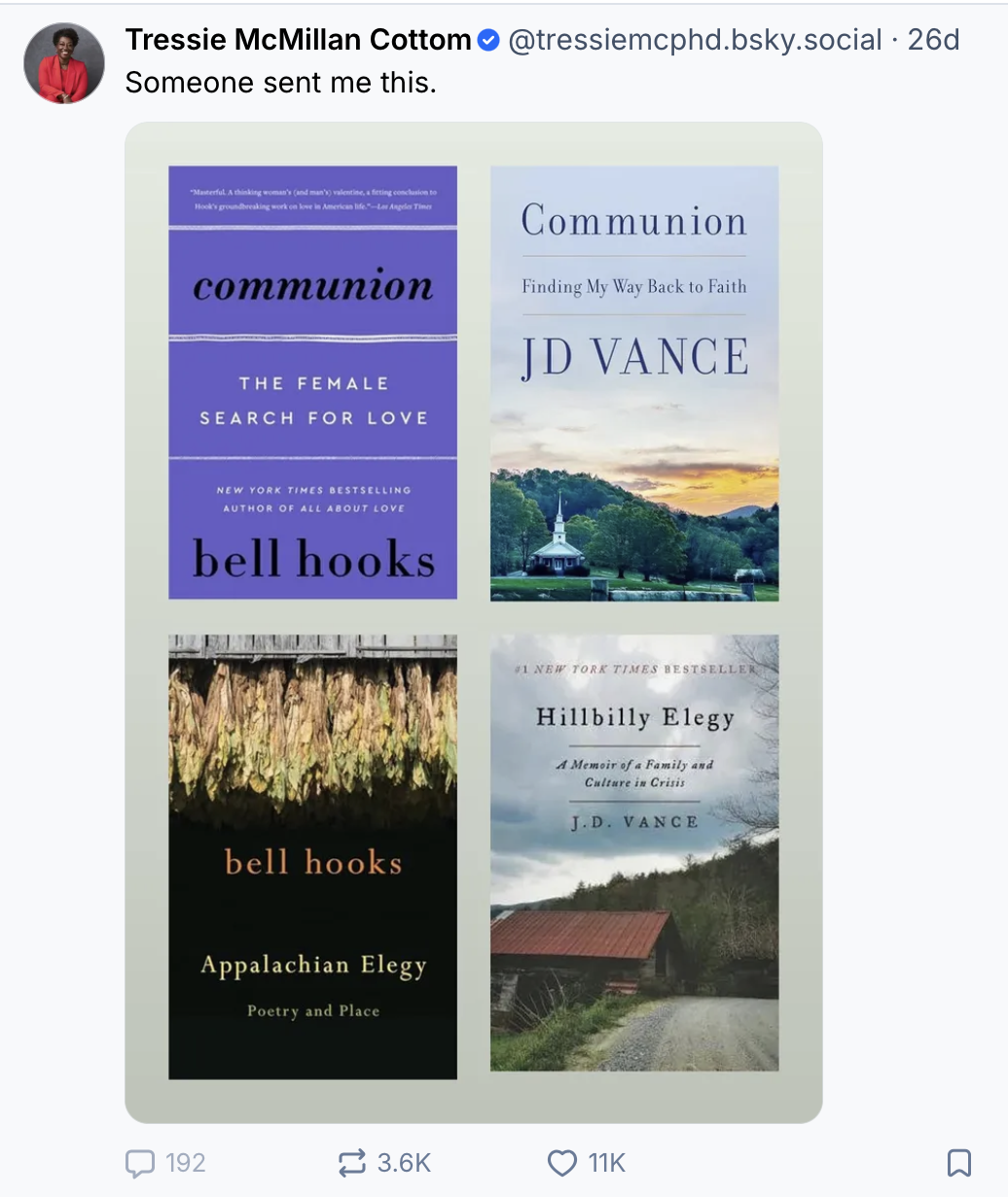
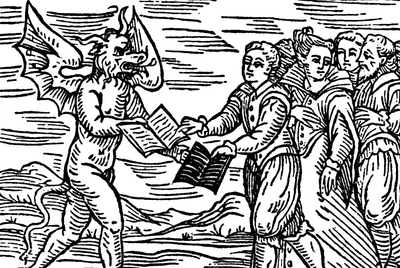
For those unfamiliar with the NYT Bestseller List dagger, it looks like this † and signifies that the book’s sales numbers include bulk purchases from one institution or special interest group (at minimum). If you have enough money, you could find a group or individual to buy thousands of copies of your book to land you a spot. While the ranking of the NYT bestseller list is somewhat mysterious and not always reflective of the actual number of sales, the dagger does inspire skepticism about a book’s true popularity. For instance, in 2019, news outlets reported that the Republican National Convention spent nearly $100,000 on Donald Trump Jr.'s book to make it a NYT Bestseller.
“Buying or hacking your way onto The New York Times Best Seller List is something afforded to the rich and privileged,” wrote Jeffrey Davies for BookRiot. “. . . one need not look far for numerous lists of right-wing American politicians who have attempted to tip the commercial sales in their favor more than once after they’d published a book.”
And look, the history of bestseller lists being cancelled and brought back in the past decade is long:
— In 2017, the NYT discontinued the graphic novels and manga bestseller list to much uproar from those communities and publishers. It also got rid of mass market paperbacks.
— In 2019, the NYT brought back its “graphic books and mass market best sellers” as monthly bestseller lists and “retired” its monthly science and sports list, folding those into nonfiction.
— In December 2022, USA Today killed its bestseller list but brought it back June 2023 with a more indie bent.
— In November 2023, the Wall Street Journal discontinued its bestseller list.
— In March 2026, the NYT got rid of its mass market paperback monthly list after writing about the format’s demise a month earlier.
I'm probably missing a couple in there. So sure, maybe the NYT’s paperback nonfiction bestseller list will return to a weekly format in however many years, but what this all inevitably comes back to is discoverability. Yours and mine. In a writing environment where no one is responsible, yet our ability to eat depends on how well we navigate the wreckage before us. A mention on the list might have (or had?) the potential to solidify a writer’s career. But the fact remains that few, if any, can hustle themselves beyond the consequences of institutional collapse.
In 2017, Rob Moor, an author and personal friend, landed on the now-defunct NYT Science bestseller list a month after his book On Trails published as a paperback, which led sales to explode. For a fun (awful) time, you can take a look (seriously— you’ve been warned) at the top books on the respective hardcover list here. Moor published his new book In Trees three weeks ago, and despite the starred reviews in Publishers Weekly and Kirkus, despite blurbs by Robert Macfarlane, Robin Wall Kimmerer, and Bill McKibben, despite an excerpt in the New Yorker, and his status as a previous NYT Bestseller, and his publisher-supported book tour, he tells me he still has no idea where people might find out his new book even exists.
I haven’t talked much about race, gender, and sexuality in this piece, but I think readers can glean that if it’s rough for non-celebrity nonfiction writers overall, certain demographics within that category are poised to fare better or worse. I am reminded of Daniel Bessner’s feature “The Life and Death of Hollywood,” which appeared in Harper’s Magazine in 2024:
“There was this feeling,” the head of the midsize studio told me that day at Soho House, “during the last ten years or so, of, ‘Oh, we need to get more people of color in writers’ rooms.’ ” But what you get now, he said, is the black or Latino person who went to Harvard. “They’re getting the shot, but you don’t actually see a widening of the aperture to include people who grew up poor, maybe went to a state school or not even, and are just really talented. That has not happened at all.” To the extent that this was better than no change, he said, “Writers’ rooms are more diverse just in time for there not to be any writers’ rooms anymore.”
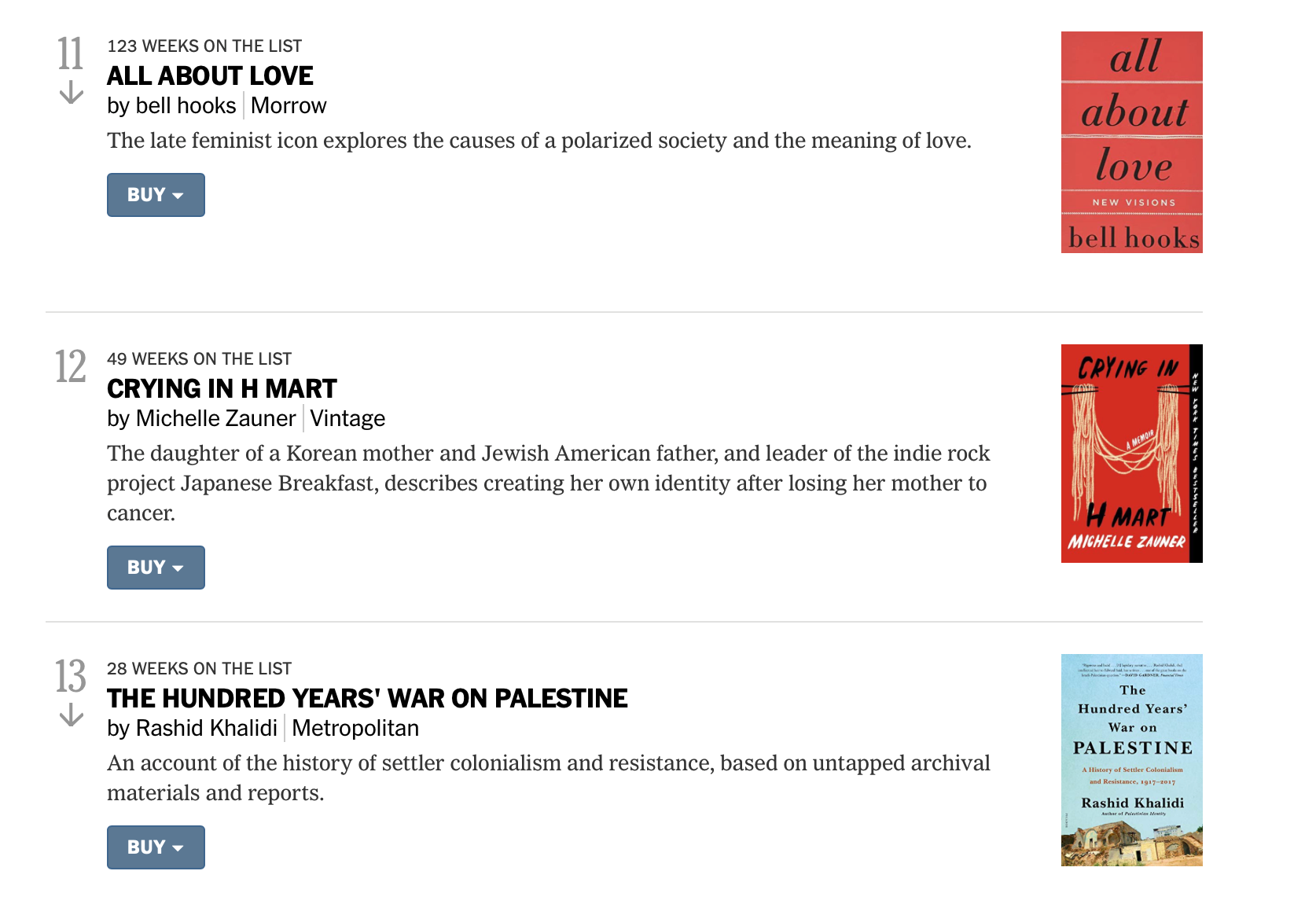
I admit I am unusual in that I’ve watched the nonfiction paperback bestseller list like a hawk for the past several years, because I believe it reveals a lot about readers. If the hardcover nonfiction list is for the haves, the paperback nonfiction list is for, well, this:
“The NYTBR probably saw an opportunity to save time tracking a poorly performing area,” my literary agent says, when I ask for her thoughts on moving the paperback nonfiction to monthly. And yes, OK — but at what cost?
Perhaps it doesn’t matter that The Hundred Years’ War on Palestine: A History of Settler Colonialism and Resistance, 1917-2017, appeared on the paperback nonfiction bestseller list three weeks after October 7, 2023 — right above its ideological opposite Israel: A Simple Guide to the Most Misunderstood Country on Earth. Nor that the former stayed, and stayed, and stayed on the list, week after week. I know because I checked. I checked while college students were being beaten, and encampments were getting shredded, and teachers — overwhelmingly of color — dismissed from their posts.
By the time The Hundred Years’ War on Palestine reached its six-month mark on the paperback nonfiction bestseller list, bell hooks’s All About Love: New Visions had entered week 121 on it; Braiding Sweetgrass: Indigenous Wisdom, Scientific Knowledge and the Teachings of Plants was approaching (and would surpass) four years on the list.
And perhaps this paperback nonfiction list during the occupation of Hind’s Hall doesn’t tell a story about the weeks beforehand, and maybe, fine, the hardcover nonfiction list the same week says nothing to you either. Collectively, I see a snapshot of the country, of publishing, of P&Ls, and bets made, and horses backed, and grifts pulled off.
This isn’t hindsight. I saw it then as clearly as I see it now, nearly two years later. If nothing else, the paperback nonfiction bestseller list, at least in the years since the COVID-19 pandemic began, has often been a reminder that there is a world beyond the United States. Beyond consumption. Beyond ourselves. There are peoples and pasts; there is nature and its plundering; there is context for how and why we got here and the ramifications that ripple beyond borders.
At the beginning of 2025, I started to look in earnest for Black writers with new books on the nonfiction bestseller lists. Not movie stars or politicians; not Just Mercy, which had sat on the list for 300 weeks, nor Michelle Obama's offerings. Not Black people who’d co-written with celebrities, and not white authors who’d written about Martin Luther King, Jr. I was looking for Black people whose profession was “writer,” or “journalist,” or even “professor,” ideally without a previous bestseller under them.
A silent quarter passed. I dropped the "ideally" part.
By mid-April, Roxane Gay’s The Portable Feminist Reader and Hanif Abdurraqib’s There’s Always This Year made appearances on the paperback nonfiction bestseller lists — the former on the strength of its preorders (and a $25 list price) and the latter on the popularity of its hardcover — but were gone a week later.
Another season came and went. Would you believe I’d reached October? When Assata Shakur died, her autobiography would grace the list for the first time. Technically this counts, I think; technically, death is a bonus. Malcolm Gladwell's latest book publishes its paperback version, and against my wishes, I must count this too. The year ends.
It is 2026, and in March my initial conditions are finally met: A. Mechele Dickerson’s The Middle-Class New Deal: Restoring Upward Mobility and the American Dream reaches the paperback nonfiction bestseller list. It’s a university press book, which means that the hardcover may cost an arm and a leg, but the simultaneously released paperback costs only $24.95. Without doubt, her appearance on Jon Stewart’s show helped her sales numbers, but I suspect it wasn't that alone.
On the final weekly paperback nonfiction bestseller list, All About Love will have spent 185 weeks on it and Braiding Sweetgrass 309.
When the now-monthly April list debuts, I watch as those counts reset to 1.
This post was edited by Maggie Mertens.
Post-Credits Scene From the Garden
Scratch is a weekly newsletter about how your favorite writers are surviving (or not). We are a four-person collective publishing essays, interviews with other writers, and topical inquiries into the publishing and media industries today. If you like what we’re doing here and want to support us, a paid subscription is the best way to do so.
Become a free subscriber to receive our weekly newsletter.

Member discussion