I Don't Miss Twitter, I Miss Zines
Manjula goes to the Santa Rosa Zine Fest and finds more future than nostalgia.
I’m driving through the parking lot of a mall in Santa Rosa, California, a couple hours north of the San Francisco Bay Area, and I’m looking for punk rockers. It’s a Saturday afternoon and traffic is stop-and-go in the lot, but unlike most of these cars, I am not trying to find a spot close to Target or Nordstrom Rack or the Tesla charging station. I’m headed to a less convenient corner of the mall’s outer ring where, next to a gas station and a freeway on-ramp that is always backed up, a squat, freestanding building houses a small branch of the local public library. This is where the Santa Rosa Zine Fest is being held, outside, in the library’s designated sub-parking-lot of the larger mall lot. I’m here because I am tired of looking at text on a tiny, angry screen, and because, like every writer I know, I am feeling uncertain about the future of traditional publishing.
I am also growing weary of talking about how bad the situation for writers is; it’s necessary, I know, but I’m increasingly interested in seeking out peers who are doing, not discoursing. Today, I’m trying to greet the future head-on. Where else to start but in a mall parking lot, with a format that is actually very old: humans, in real life, circulating published materials on paper.
The Santa Rosa Zine Fest, unlike some of its larger and more urban brethren, is just four years old, and it’s small. Cosponsored and hosted by the Sonoma County Public Library and the Santa Rosa Zine Collective (SRZC), this year the festival featured a series of zine-related workshops and events for adults and teens leading up to the main fair, during which about sixty exhibitors are gathered to trade, sell, and share their zines with one another at tables in the mall parking lot.
What’s a zine fest, you ask? It’s kind of like AWP, but actually cool.
Enjoying Scratch? The best way to support our work is with a paid subscription!
For those who may not have caught the Gen X cultural nostalgia train, zines are, generally speaking, self-published, self-made, self-distributed publications. With an etymology stemming first from “magazine,” then “fanzine” (now we also have “perzines,” a newish if somewhat redundant subgenre denoting personal/identity based narratives), zines might focus on a band or music scene (Bikini Kill was a zine as well as a band), a personal history, a visual arts theme, politics … truly anything goes. Zines are different from magazines in that they are shorter (no apostrophe, even!), usually made by individuals, and don’t generally make much money, if any. While zines are not blogs, they are similar in that they are often personal or personality-driven serial publications with small but devoted audiences. Although most current grownups associate them with the punk and DIY music subcultures of the past fifty years, zines have been a staple of counterculture movements in the US since at least the early twentieth century. Indeed, one could make a strong argument that town-crier-style pamphlets and broadsheets were precursors to zines; I mean, isn’t a codex, too, a sort of zine? Debate in the comments…
I can draw a direct line from my teenage interest in zines to my career as a writer and editor. Over the decades, as I’ve circled around again (and again!) to precarity, and burnout, and This Economy, ad infinitum, I cannot count the number of times I have declared that I’ve had enough of this bullshit, I am done — with publishing/media, books/magazines, writing/editing, all of these sucky corporate mediums — and I am gonna call it quits and just go back to making zines. I haven’t done so yet. But try me, I still might.
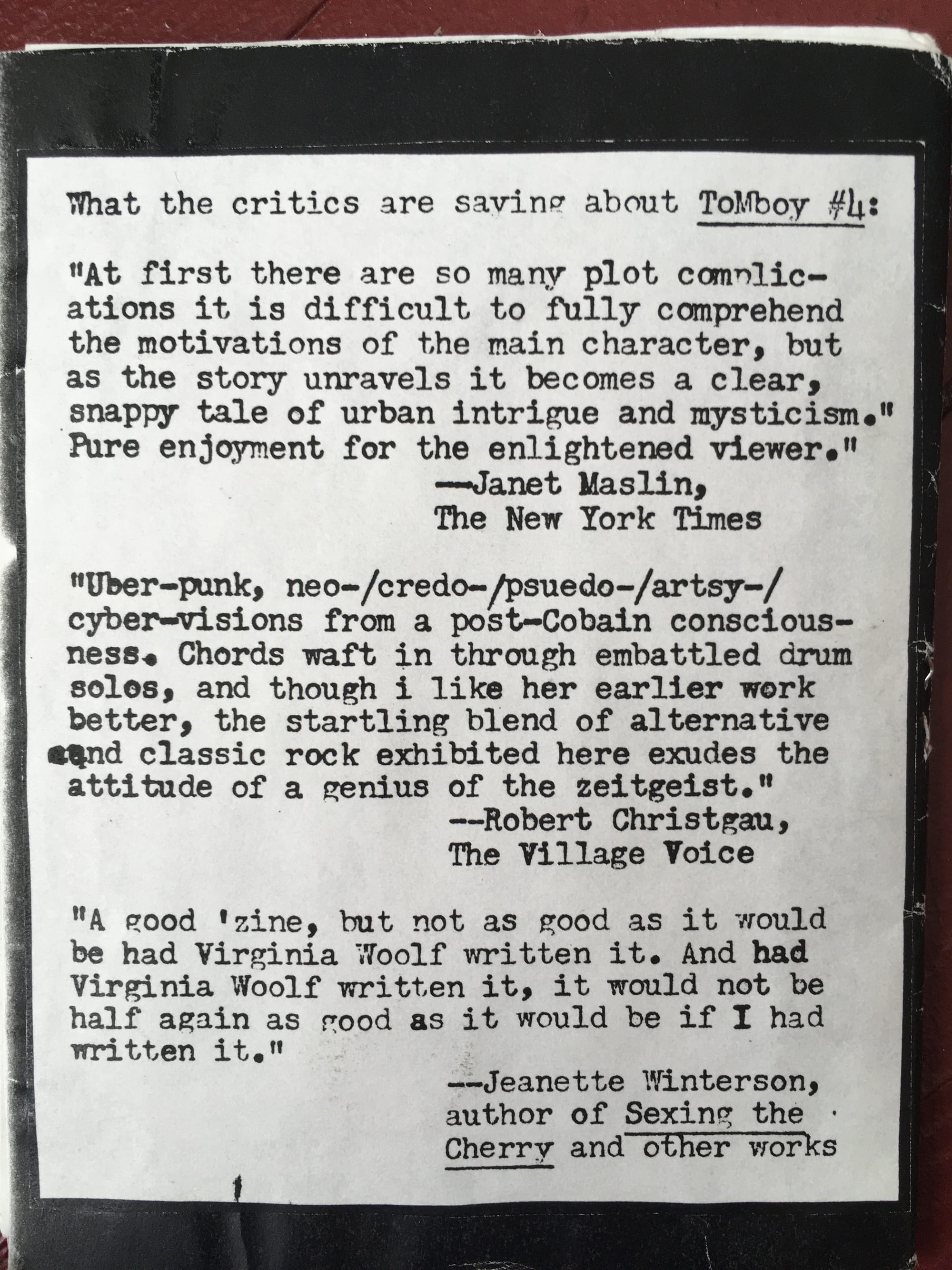
In truth my own zine career was brief, if romantically inflated in my memory: Between the ages of 17 and 20 I put out a handful of editions of a small zine called tomboy. (Look, it was the '90s, and at the time such a title denoted transgressive gender politics, I guess?) The production process consisted of a week or two of evenings after work (retail jobs, of course) sequestered in my bedroom with a manual typewriter, Xerox paper I stole from the copy shop, ripped-out magazine pages and other found collage art, and a lot of glue sticks and Scotch tape. I’d fiddle with the fold, layout, and text endlessly, re-sticking and -typing until I was satisfied, then run everything down to the 24-hour Kinkos (iykyk) on the bus in a paper bag and spend a whole night, sometimes two, figuring out how to make two-sided copies that folded into little books correctly (and how to steal copies using the little clicker-thing that counted them, before they had computerized machines).
Add in a few rounds of near-lethal paper cutter usage, a bout with the dreamy office-sized stapler, and I’d end up with maybe 50 copies of my zine, which I then gave out to friends and family, sent in the mail to other zinemakers as trades, and sold for a buck or two on consignment at local shops. A high point was placing one (1) copy at the legendary Epicenter Zone, a punk collective located above a pay-by-the-pound thrift store on Valencia Street in San Francisco. (According to Google Maps, as of January 2025 the same storefront that housed Epicenter was now a bougie yoga place; the upstairs appeared to be vacant.)
So when I head to the zine fest, I am perhaps looking for something that I think I may have recently lost track of, a couple decades into a peripatetic but also arguably successful career in publishing: the drive, freedom, and confidence to just make something. No promise of audience or sales, no discourse, no regrets.
Before I scope the scene in the parking lot, I visit the library, where I use the (free, clean) bathroom and say hey to the giant statue of Lucy from Peanuts (it’s a Sonoma County thing). I send up a silent prayer of gratitude to the public commons for the continued existence of the library system in These Times. I then steel myself for a big crowd – I’m not very extroverted, and today I’m already wishing I was at home on my couch with a book and a cup of tea – and head into the indie fray.
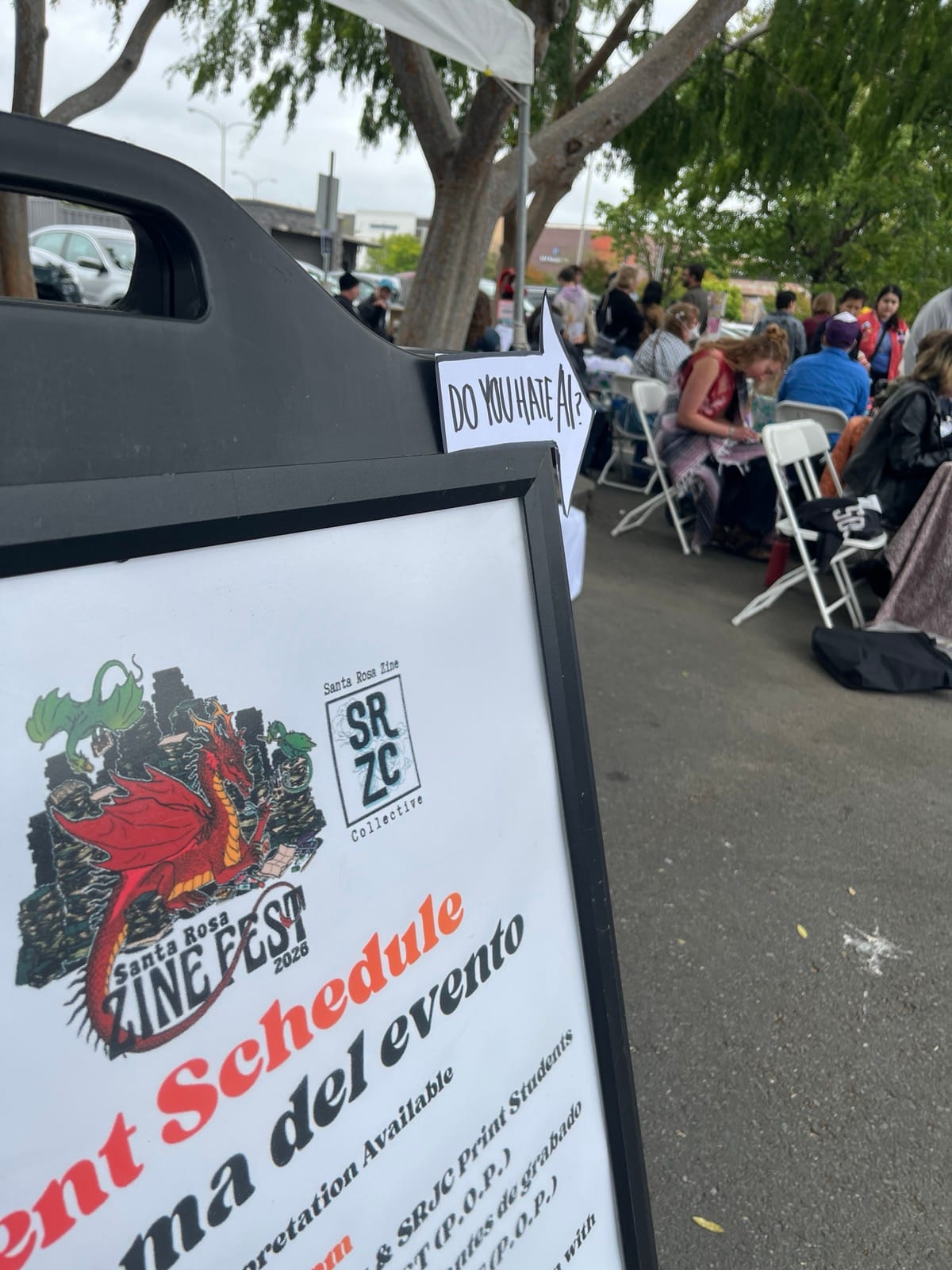
At the entrance to the tabling area the organizers, all big smiles, thrust upon me a map of the fair that is also — of course — a zine, with versions available in Spanish and English. The exhibitor tables are in a loosely circular arrangement; across the blacktop there’s a workshop area where the SRZC is finishing up a trilingual (English/Spanish/ASL) workshop with attendees making zines about “how they use language, the language of their ancestors, and the importance of all languages.” Over at another table, local artist Ash Hay and a group of junior college printmakers are holding an all-day screenprinting session for political art. I make a mental note to come back to the screenprinting, but I never do, because I haven’t allowed myself enough time, because I soon realize that I want to stop at every table and talk to every zinester and look at — and touch — every publication on display.
Among the many senses put to work in reading and viewing zines, touch is a strong focus. Each zinemaker makes a point of telling me to pick up the wares, to handle them and leaf through them. “Please touch the zines!” a handwritten sign says. There is also a noticeable lack of prominent Venmo QR codes or other currency. People are definitely selling things, but most tables also feature signage stating that trades — of zines, art, or other creative stuff — are welcome. Perhaps more remarkably, I note a distinct lack of that palpable tang of neediness that thickens the atmosphere of most writing-related fairs and conferences. The silent, verging-on-vampiric questions hidden in the eyes of every striving writer who smiles at another writer, glances at their lanyard nametag, then searches their face for recognition: Who are you? What might you do for my career? Are we “networking” yet?
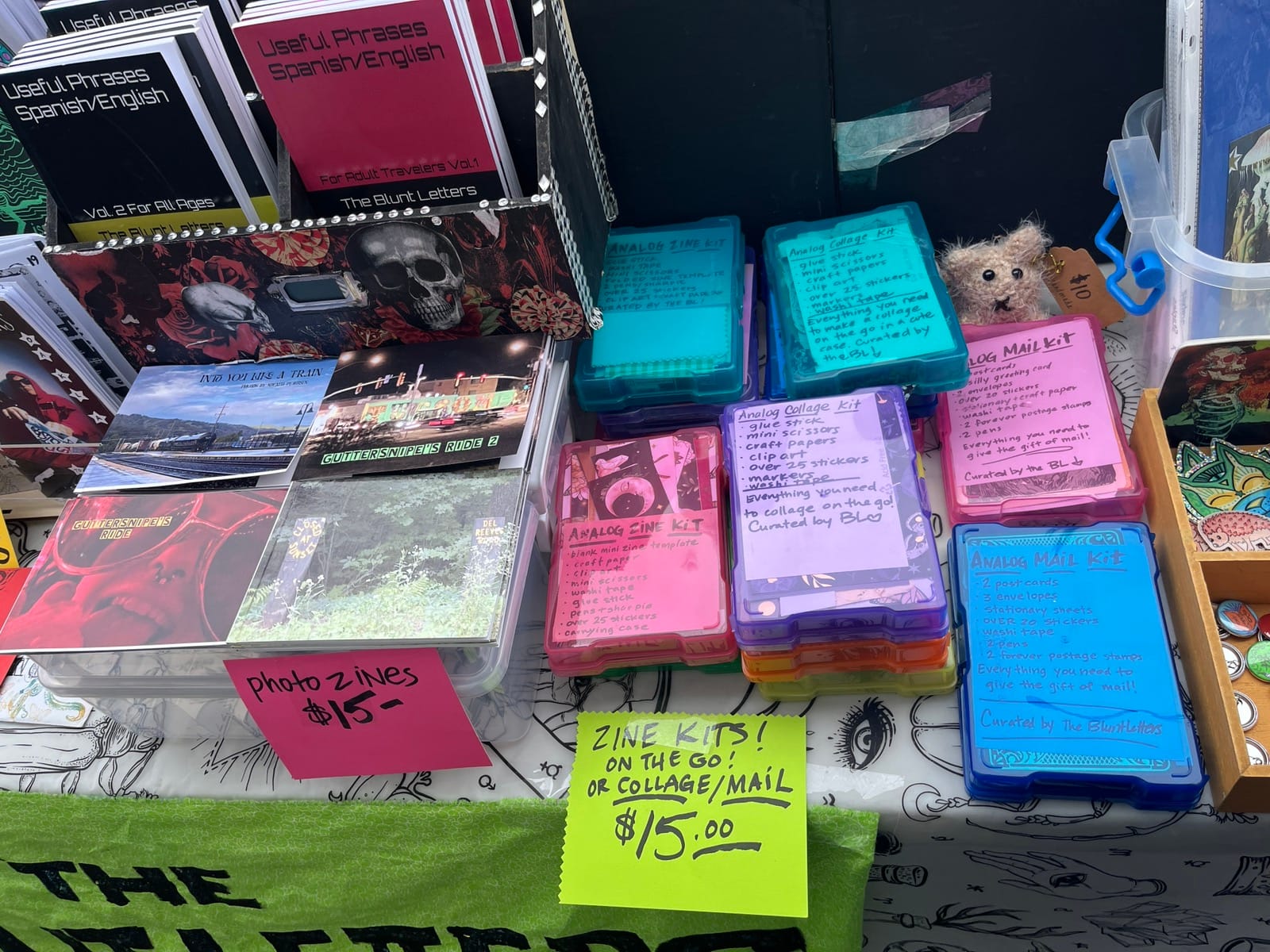
My other motivation for coming here is, of course, to write about it for Scratch. I’m supposed to be a reporter today: My plan is to interview a few zinemakers about how they’re surviving and turn it into a nice little feature for y’all to read. I even had a cutesy gimmick in mind for this piece, wherein I would spend only $32 at the zine fest — the price of a hardcover book — and come away with a bag full of literary largesse. (Most of the zines I’m seeing cost between $2 to $10, depending on slickness and cost of production). I quickly realize my schtick won’t work, not because zines are too expensive, but because I want to buy them all.
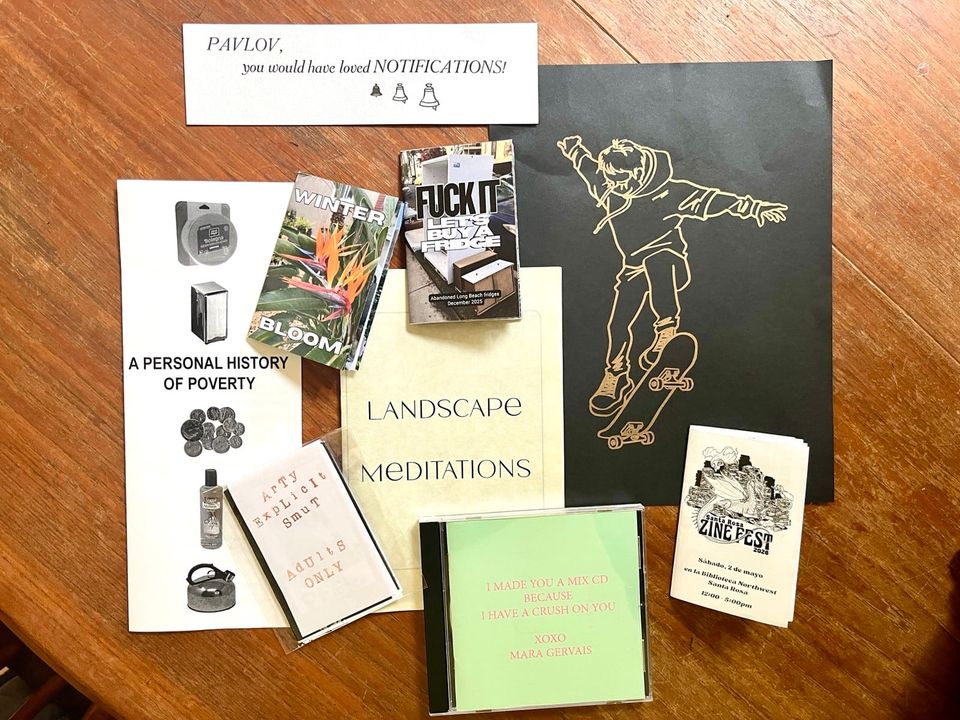
I instead limit myself to no more than two things from any single vendor. From a fellow middle-aged white lady in chunky eyeglasses frames, I buy a zine called “Arty Explicit Smut” (it’s sealed, and upon opening it at home I discover it’s actual porn, and not bad at that.) Next, I have a hard time choosing between photography zines being sold by a friendly community college teacher named Sarah Bennet. Bennett tells me she used to be a journalist. Her titles are hard to resist: “FUCK IT LET’S BUY A FRIDGE” ; “LAWN ORNAMENT MURDER SCENES”; “POP PUNK SAVED MY LIFE”. Despite having already given up on my reporter act, I find myself asking the author questions, not because I want to turn our interaction into Content, but because I’m genuinely curious.
She tells me she’s driven up from Orange County – a seven hour trip – just for the festival. She teaches journalism at a community college there, makes zines on the side, and every year just hopes that her union job’s cost-of-living wage increase covers her rent raise. She has resigned herself to not making money from her own writing, and to never owning a home. And she’s the cheeriest person I talk to today. She’s also hilarious. I go for the fridges zine and another one featuring flowers, my personal weak spot.
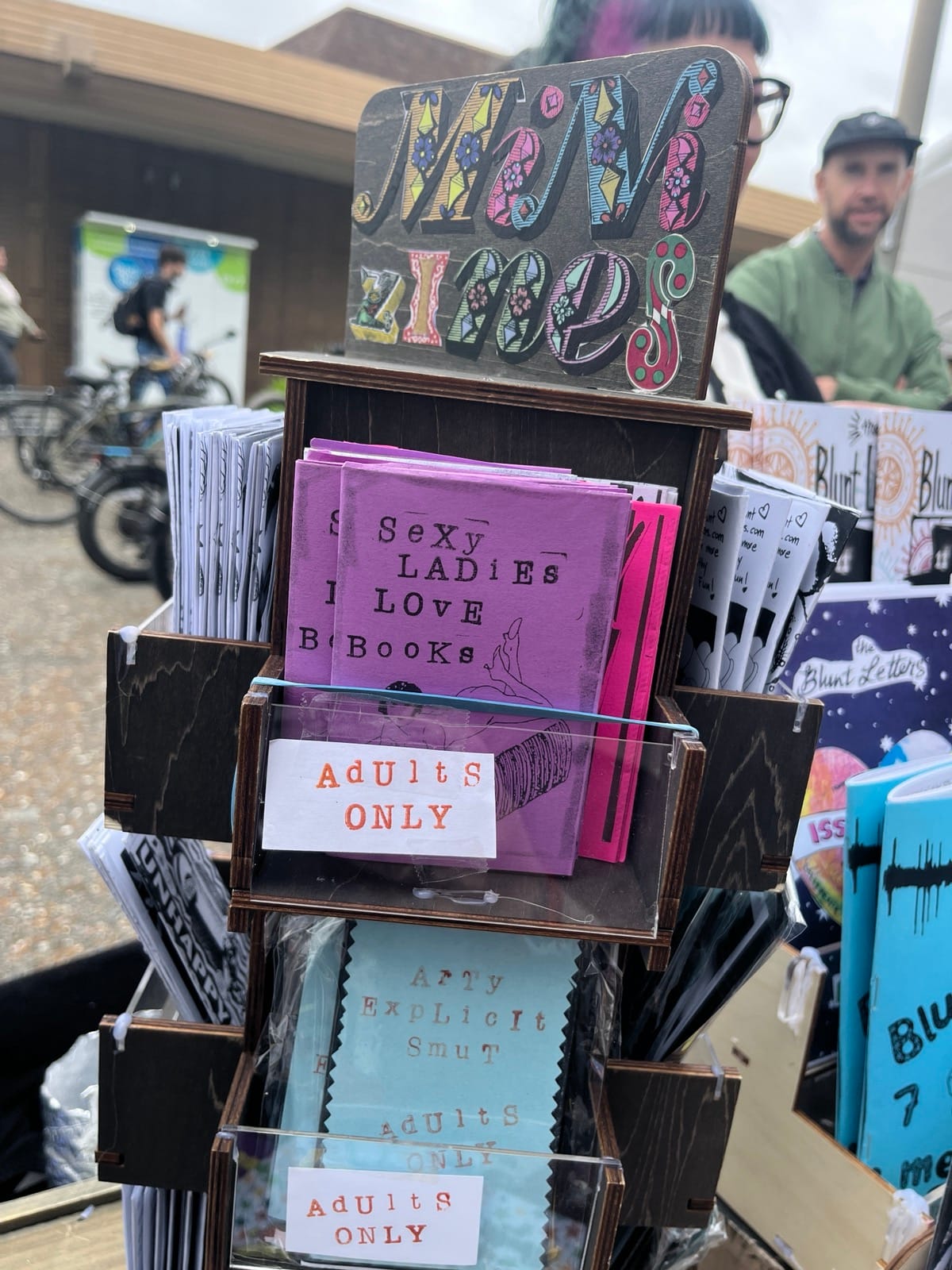
The zine fest, it bears noting, is the most diverse literary event I’ve been to in a while, in all ways: class, race, gender expression, age, and genre. I look at — and touch — zines about grief, about shit your therapist says, about body and sex and food (so many zines about food!), ancestral plant knowledge, immigrant solidarity, gender identity, views from train windows, relationships, neurodivergence, parenting, anime, sewing, and, of course, bands.
At the half-hour mark I start to feel overwhelmed.
I recognize the feeling. It’s not dissimilar from the one that overcomes me when I realize I’ve been scrolling for too long. In that way, a zine fair’s deluge of content is not unlike that of the timeline, I suppose. Except it’s the opposite of the timeline in that everyone is stoked to be there. The zinesters are excited to be sharing, and I’m excited to be shared with. It is an overwhelm teeming with the specificity of intention, of thoughtful creative and formal constraints, and of generosity. It feels deeply unfamiliar.
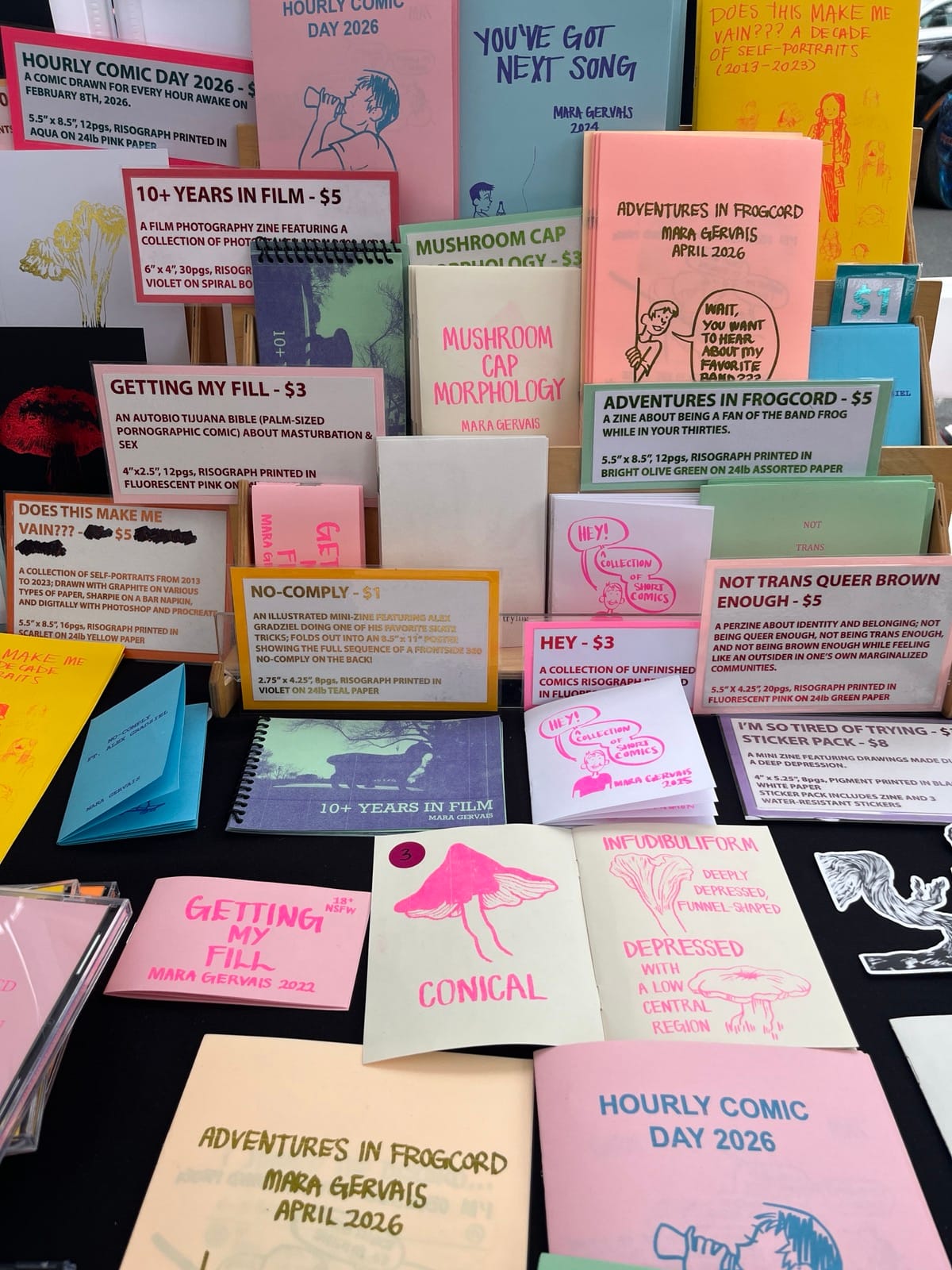
I chat for a while with Mara Gervais, a zine maker and artist from the Central Valley who prints on a risograph printer. I ask about the cost of printing–in a post-Kinkos era, it can’t be as cheap to make zines as it was back in the days of my youthful retail thievery. Gervais says a container of risograph ink costs about $40 but, they say, “it lasts forever.” I buy a print of a skater doing a kickflick and a CD “zine” — a mix CD with liner notes that double as a zine detailing the stories and significance of each song in the author’s life —for a total of $30, almost a whole container of ink (or a whole hardcover book).
I stop by the table of a friend of mine, Christie George, who is there with one of her sons, Ellis. Ellis is getting in on the spirit of the day, displaying little hand-drawn pictures that he’s cut up like puzzle pieces — “No, they’re free!” he corrects me, when I ask what he’s selling — and Christie is selling her own self-published book, one of the few actual hardcovers I see today. Next to their table is that of a quiet librarian — library worker, they specify, they’re still in school for their certification — who sells me a zine called A PERSONAL HISTORY OF POVERTY that contains a verbatim quote from their landlord’s last attempt at an eviction threat. They throw in a bookmark that says, “PAVLOV, you would have loved NOTIFICATIONS!”
I think of the library worker, who goes only by the moniker Palace of Fruit, a few tables later, when a hint of sadness creeps in as I overhear a zinemaker and his customer talk about how everything is so hard right now that it’s difficult to make art at all. This is literally the only negative statement about creative work that I have heard today. But, these artists soon make clear, it’s just painting that’s hard; “you can always make zines!” I exhale, relieved. The vendor enthusiastically details the issues he has on display, and everyone’s zine buzz is maintained, un-harshed.
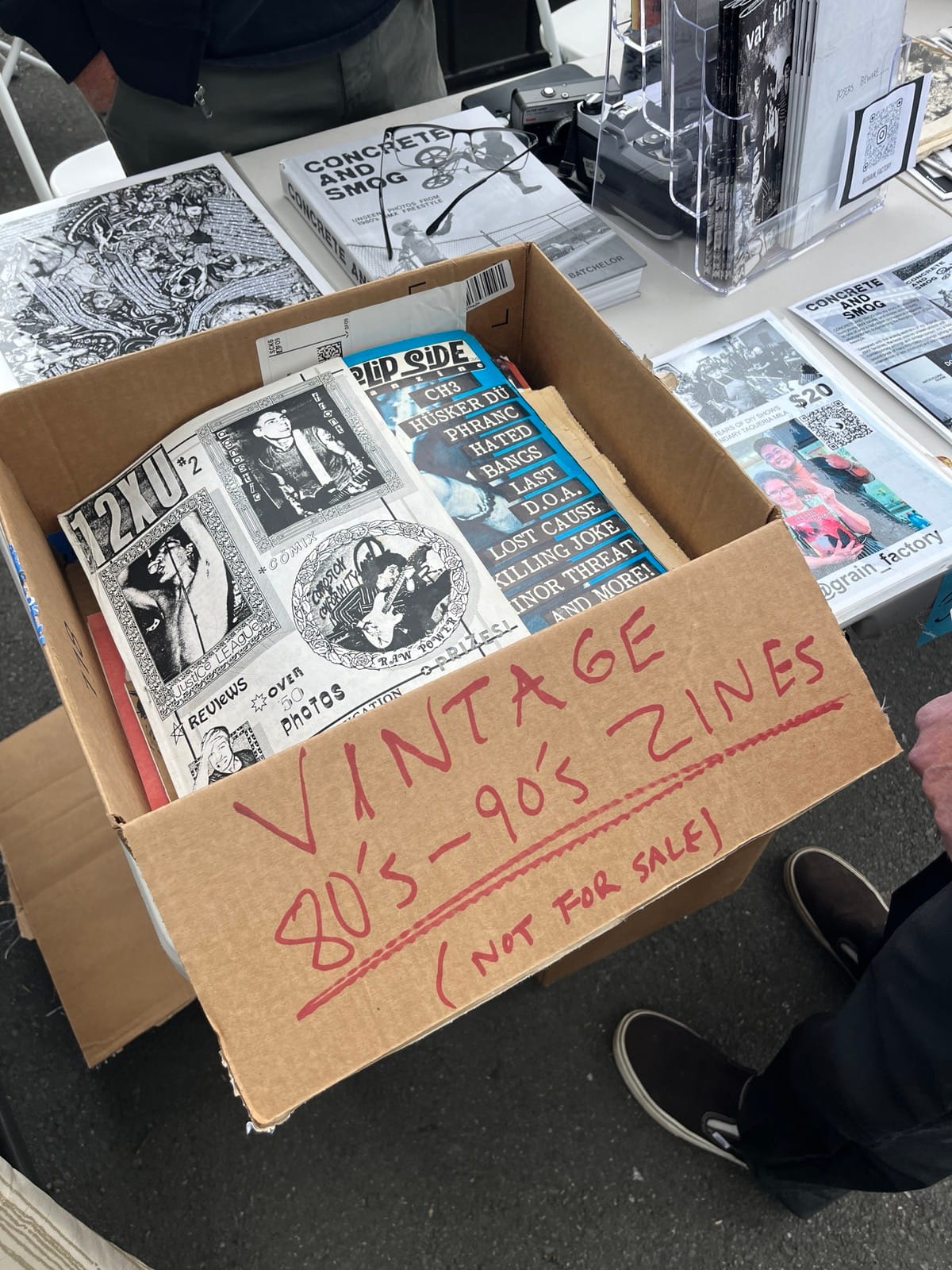
I turn a corner into the “aging punks aisle,” as one exhibitor terms it, which features actual fanzines from the '80s and '90s. This is the topic I had initially expected to be most drawn to today, as an aging sort-of punk myself. But it’s the younger publishers I’m actually smitten with, and I find myself skipping the archival stuff to talk to an exhibitor from a local high school’s zine-making class project. Their table displays a range of titles, including such instant gems as “6 Invasive Plants in Sonoma County,” “Different Types of Hugs and What They Mean”, “Know Your Rights Against ICE,” and the evergreen cultural topic “How Did Marilyn Monroe Really Die?”
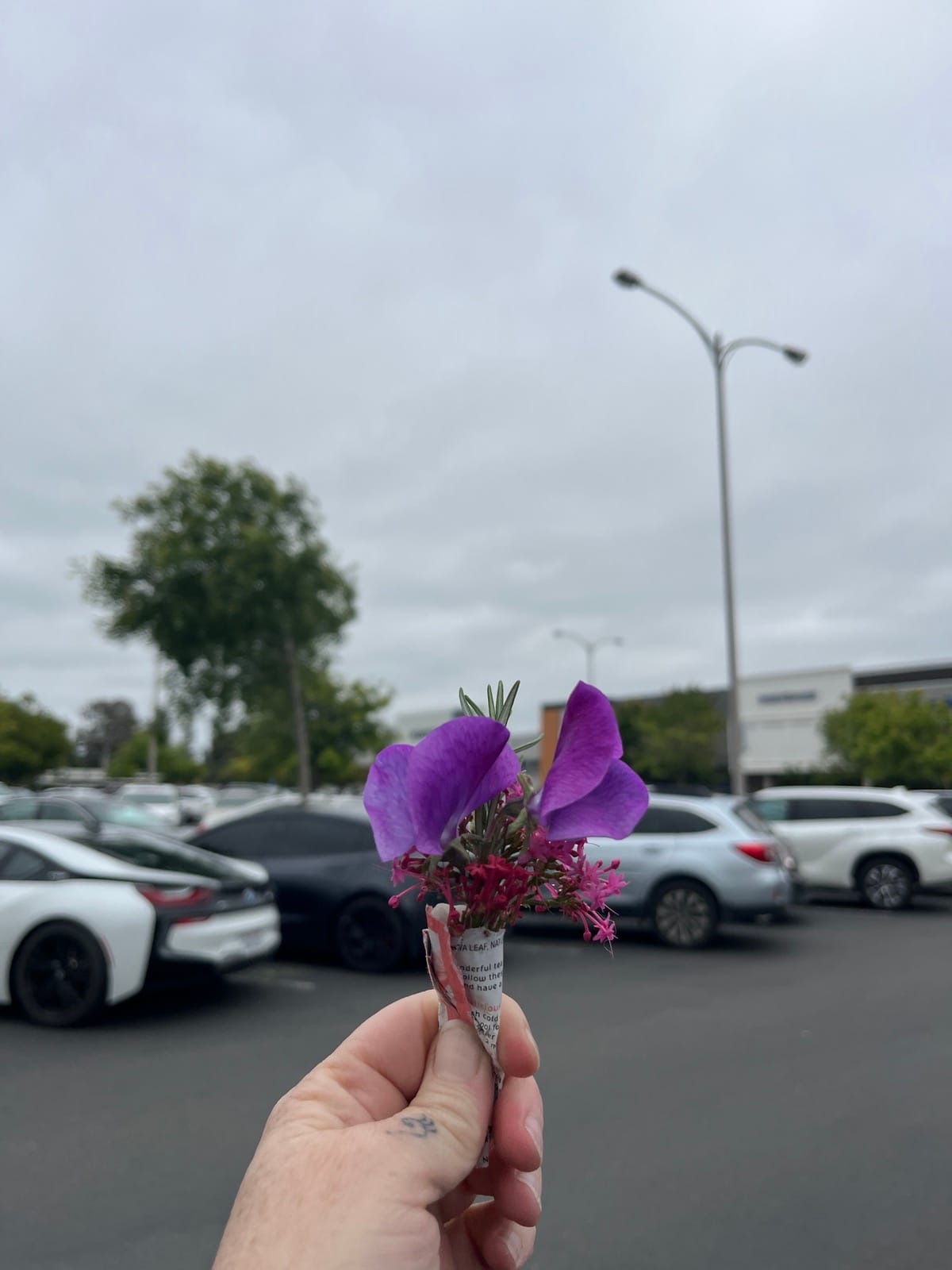
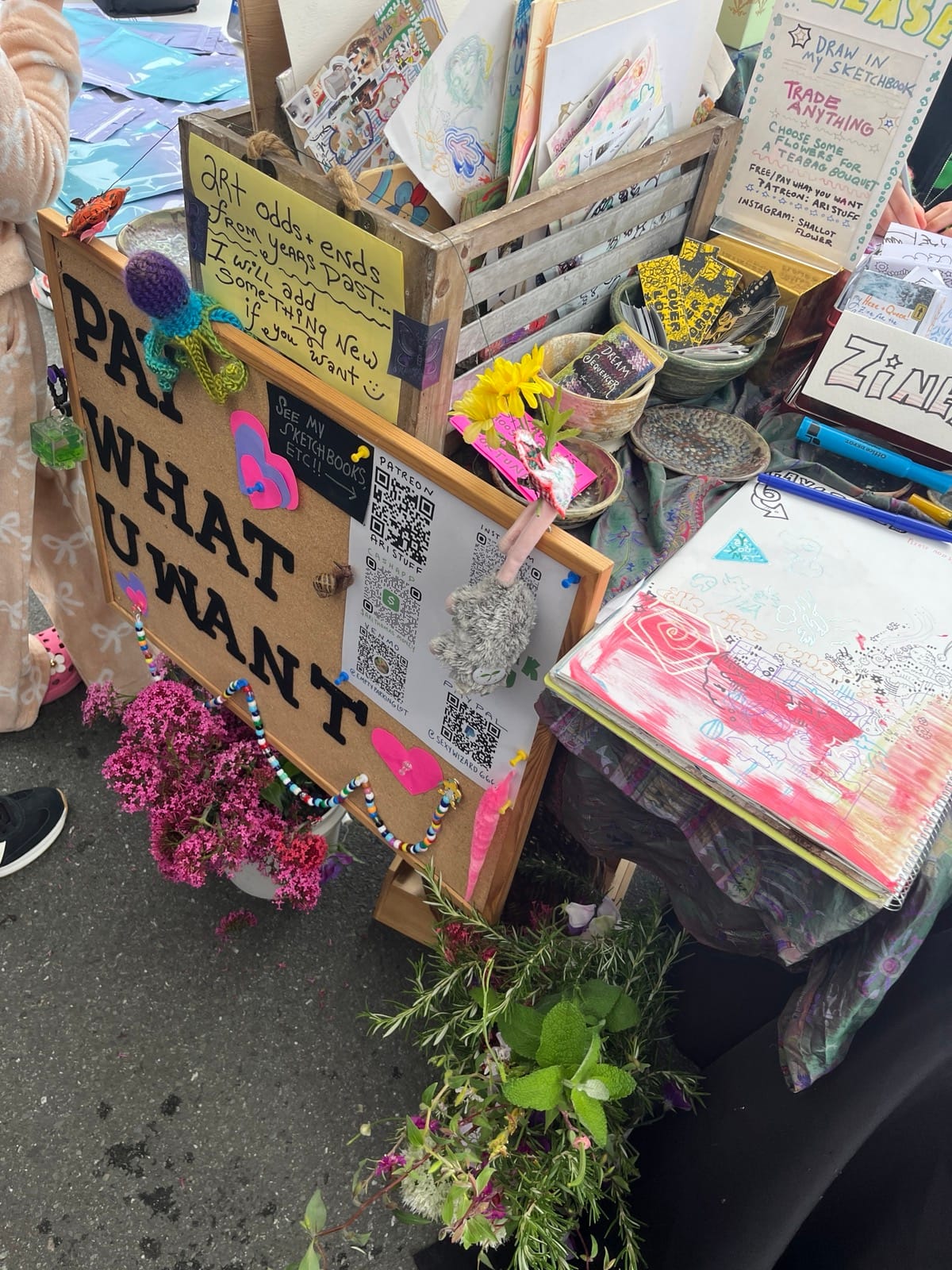
Another enterprising young publisher — maybe in their early twenties, I’m guessing — has a full station of pay-what-you-wish services. They’re offering zines, yes, but also an opportunity to draw in their sketchbook, play some sort of tarot-like card game, and — this one ropes me in — select a few small stems of flowers from the buckets of blooms they have under their table. They take my selections and craft a tiny bouquet for me, wrapping the stems in a wet piece of paper towel and securing them inside a foil-lined teabag wrapper. It’s not a zine, but it is a form of language.
When the diminutive scent of sweet peas and rosemary hits my senses, I decide that actually, I am not a journalist today, I am not an author, I am not even a newsletterer. I am a fan.
I carry the bouquet out of the library parking lot and away from the cheery, all-ages crowd and I cross an invisible border into the mall parking lot, back to the rest of the normcore world.
Lately it seems like every author I talk to is worried about discoverability. Now that the internet is so awful, where will people learn about how to read our stuff, we ask? Most of those conversations mention the lack of a common gathering place, which usually means an online gathering place, and often includes some reference to Twitter — specifically, the brief era of social media usage in the twenty-teens that some called “literary Twitter,” when a lot of authors and journalists spent a lot of time on a certain website talking to one another, and it was possible at that moment to gain readership and some sense of community through that venue. But there’s something about this perennial conversation that never sits quite right with me. Yes, that website was a place where we made friends and found readers. I don’t deny that. It was often enjoyable, and obviously quite addictive. But I don’t want it back. I don’t want to find another place like it. I don’t want to miss a corporation that was making money off my free labor, and that actively and arguably used that labor to build the horrible internet of right now that is displacing writers entirely from the ecosystems they enriched. The word “discover” should be used for better things.
Back at my car, I put my tiny zine bouquet in my cup holder. I slide the CD mix I bought from the Davis skater artist in the stereo and look in the rearview mirror and straighten the pink baby barrette in my hair and I think to myself, you miss this. People. Making weird art. Being enthusiastic. Nerds. Sharing stuff. Embracing. You miss easy and cheap access to the tools you need to make and put a good thing out into the world. Distribution without middlemen, and control of it. The ability to say “no charge” to someone, and the ability to keep on walking if you don’t want to look at what's being put in front of you. What a discovery, the renewed simplicity of this type of relationship with cultural labor.
I know I can’t really quit my paid editing job and do #zinelife. Much of zines’ power lies in their smallness; they don’t scale well, nor should they. They are not a means to a living. My grownup, burnout writer angst hasn’t been magically cured in one afternoon. All my feelings of precarity, the uncertainty about what’s next, the what happened tos and the what the fucks are valid and real. But so is this one, simple, foolproof trick to succeed at writing:
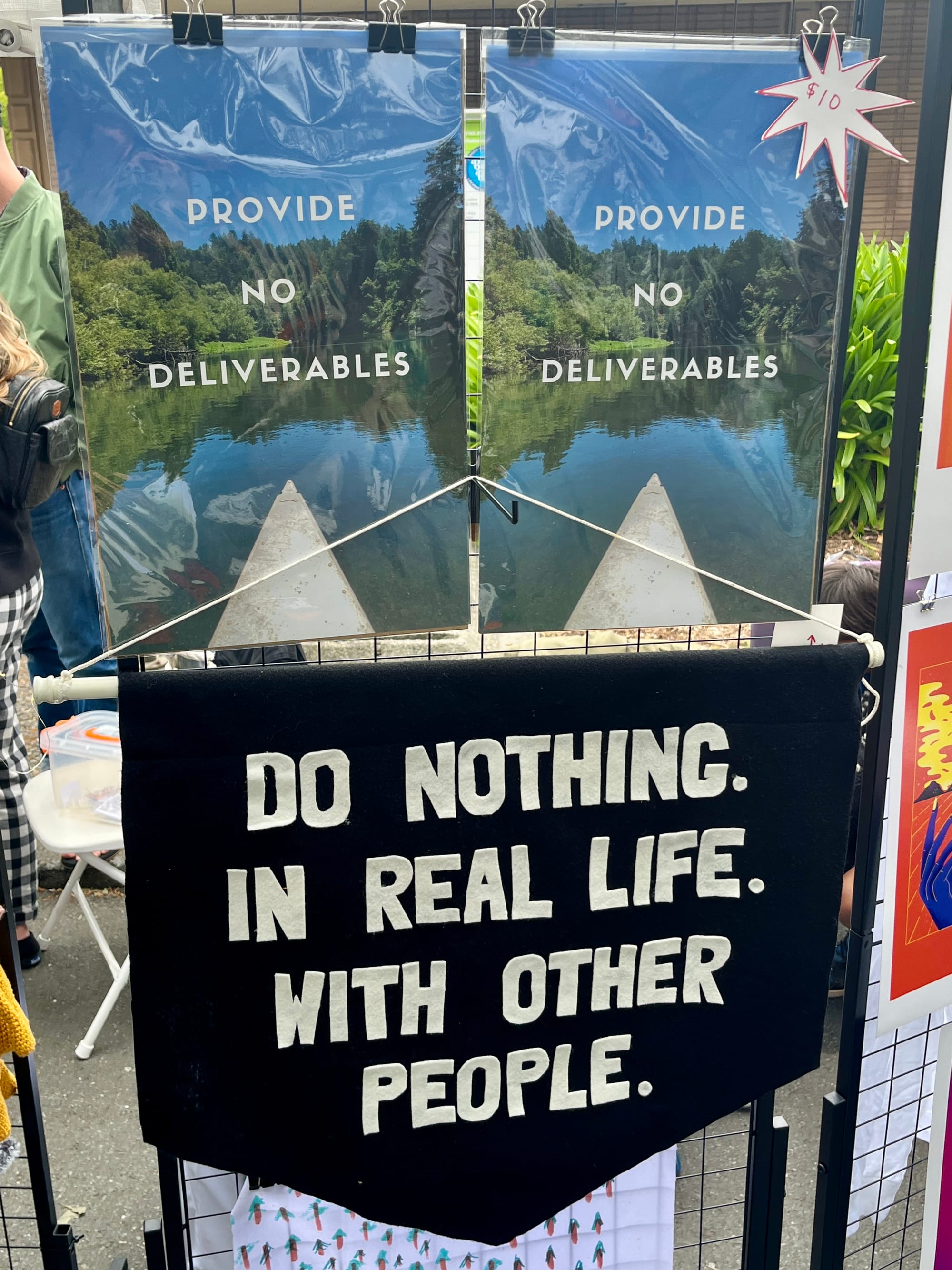
Get off the internet. Make shit. Talk to other humans about it. Touch paper.
This essay was edited by Maggie Mertens.
How to Make a Zine (Barnard)
How to Make a Zine (Jennifer Casa)
How to Make a Zine (Austin Kleon)
Black Zine Fair
Brown Recluse Zine Distro
Making Things Together: Zines as strategy and survival (Kelly Hayes, Interview with Mariame Kaba and Red Schulte)
One Million Experiments Zines
Interrupting Criminalization Zine
Interference Archive
24 HeartattaCks in 24 Hours at the Zine Archive and Publishing Project in Seattle, Vol. 1 Brooklyn
Scratch is a weekly newsletter about how your favorite writers are surviving (or not). We are a four-person collective publishing essays, interviews with other writers, and topical inquiries into the publishing and media industries today. If you like what we’re doing here and want to support us, a paid subscription is the best way to do so.
Become a free subscriber to receive our weekly newsletter.


Member discussion